In mathematical logic and computer science, the calculus of constructions (CoC) is a type theory created by Thierry Coquand. It can serve as both a typed programming language and as constructive foundation for mathematics. For this second reason, the CoC and its variants have been the basis for Rocq and other proof assistants.
Some of its variants include the calculus of inductive constructions (which adds inductive types), the calculus of (co)inductive constructions (which adds coinduction), and the predicative calculus of inductive constructions (which removes some impredicativity).[citation needed]
General traits
editThe CoC is a higher-order typed lambda calculus, initially developed by Thierry Coquand. It is well known for being at the top of Barendregt's lambda cube. It is possible within CoC to define functions from terms to terms, terms to types, types to types, and from types to terms.
The CoC is strongly normalizing, and hence consistent.[1]
Usage
editThe CoC has been developed alongside the Rocq proof assistant. As features were added (or possible liabilities removed) to the theory, they became available in Rocq.
Variants of the CoC are used in other proof assistants, such as Matita and Lean.
The basics of the calculus of constructions
editThe calculus of constructions can be considered an extension of the Curry–Howard isomorphism. The Curry–Howard isomorphism associates a term in the simply typed lambda calculus with each natural-deduction proof in intuitionistic propositional logic. The calculus of constructions extends this isomorphism to proofs in the full intuitionistic predicate calculus, which includes proofs of quantified statements (which we will also call "propositions").
Terms
editA term in the calculus of constructions is constructed using the following rules:
- is a term (also called type);
- is a term (also called prop, the type of all propositions);
- Variables () are terms;
- If and are terms, then so is ;
- If and are terms and is a variable, then the following are also terms:
- ,
- .


In other words, the term syntax, in Backus–Naur form, is then:

The calculus of constructions has five kinds of objects:
- proofs, which are terms whose types are propositions;
- propositions, which are also known as small types;
- predicates, which are functions that return propositions;
- large types, which are the types of predicates ( is an example of a large type);
- itself, which is the type of large types.
β-equivalence
editAs with the untyped lambda calculus, the calculus of constructions uses a basic notion of equivalence of terms, known as -equivalence. This captures the meaning of -abstraction:


-equivalence is a congruence relation for the calculus of constructions, in the sense that
- If and , then .


Judgments
editThe calculus of constructions allows proving typing judgments:
- ,

which can be read as the implication
- If variables have, respectively, types , then term has type .


The valid judgments for the calculus of constructions are derivable from a set of inference rules. In the following, we use to mean a sequence of type assignments ; to mean terms; and to mean either or . We shall write to mean the result of substituting the term for the free variable in the term .




![{\displaystyle B[x:=N]}](https://wikimedia.org/api/rest_v1/media/math/render/svg/61566653d9ef5af79e883a86e031d16e4626e2bf)

An inference rule is written in the form
- ,

which means
- if is a valid judgment, then so is .


Inference rules for the calculus of constructions
edit1.

2.

3.

4.

5.
![{\displaystyle {\Gamma \vdash M:(\forall x:A.B)\qquad \qquad \Gamma \vdash N:A \over {\Gamma \vdash MN:B[x:=N]}}}](https://wikimedia.org/api/rest_v1/media/math/render/svg/28333e638179f17baa4c4ac9bc55476dd9d90f23)
6.

Defining logical operators
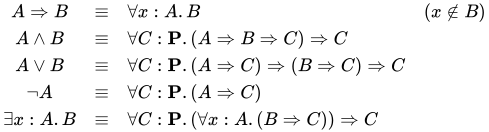
editThe calculus of constructions has very few basic operators: the only logical operator for forming propositions is . However, this one operator is sufficient to define all the other logical operators:

Defining data types
editThe basic data types used in computer science can be defined within the calculus of constructions:
- Booleans
- Naturals
- Product
- Disjoint union




Booleans and Naturals are defined in the same way as in Church encoding. However, added problems arise from propositional extensionality and proof irrelevance.[2]
See also
edit- Pure type system
- Lambda cube
- System F
- Dependent type
- Intuitionistic type theory
- Homotopy type theory
References
edit- ^ Coquand, Thierry; Gallier, Jean H. (July 1990). "A Proof of Strong Normalization for the Theory of Constructions Using a Kripke-Like Interpretation". Technical Reports (Cis) (568): 14.
- ^ "Standard Library – The Coq Proof Assistant". coq.inria.fr. Retrieved January 17, 2026.
Sources
edit- Coquand, Thierry; Huet, Gérard (1988). "The Calculus of Constructions" (PDF). Information and Computation. 76 (2–3): 95–120. doi:10.1016/0890-5401(88)90005-3.
- Also available freely accessible online: Coquand, Thierry; Huet, Gérard (1986). The calculus of constructions (Technical report). INRIA, Centre de Rocquencourt. 530.
Terminology is rather different. For example, () is written [x : A] B.
- Also available freely accessible online: Coquand, Thierry; Huet, Gérard (1986). The calculus of constructions (Technical report). INRIA, Centre de Rocquencourt. 530.
- Bunder, M. W.; Seldin, Jonathan P. (2004). Variants of the Basic Calculus of Constructions (Report). CiteSeerX 10.1.1.88.9497.
- Frade, Maria João (2009). "Calculus of Inductive Constructions" (PDF). Archived from the original (talk) on 2014-05-29. Retrieved 2013-03-03.
- Huet, Gérard (1988). "Induction Principles Formalized in the Calculus of Constructions" (PDF). In Fuchi, K.; Nivat, M. (eds.). Programming of Future Generation Computers. North-Holland. pp. 205–216. ISBN 0444704108. Archived from the original (PDF) on 2015-07-01. – An application of the CoC

