Clock angle problems relate two different measurements: angles and time. The angle is typically measured in degrees from the mark of number 12 clockwise. The time is usually based on a 12-hour clock.
A method to solve such problems is to consider the rate of change of the angle in degrees per minute. The hour hand of a normal 12-hour analogue clock turns 360° in 12 hours (720 minutes) or 0.5° per minute. The minute hand rotates through 360° in 60 minutes or 6° per minute.[1]
Equation for the angle of the hour hand
edit
where:
θ is the angle in degrees of the hand measured clockwise from the 12
H is the hour.
M is the minutes past the hour.
MΣ is the number of minutes since 12 o'clock.
Equation for the angle of the minute hand
edit
where:
θ is the angle in degrees of the hand measured clockwise from the 12 o'clock position.
M is the minute.
Example
edit
The time is 2:20. The angle in degrees of the hour hand is:
The angle in degrees of the minute hand is:
Equation for the angle between the hands
edit
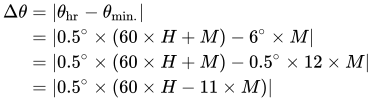
The angle between the hands can be found using the following formula:
where
H is the hour
M is the minute
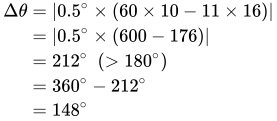
If the angle is greater than 180 degrees then subtract it from 360 degrees.
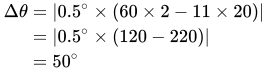
Example 1
edit
The time is 2:20.
Example 2
edit
The time is 10:16.
When are the hour and minute hands of a clock superimposed?
edit
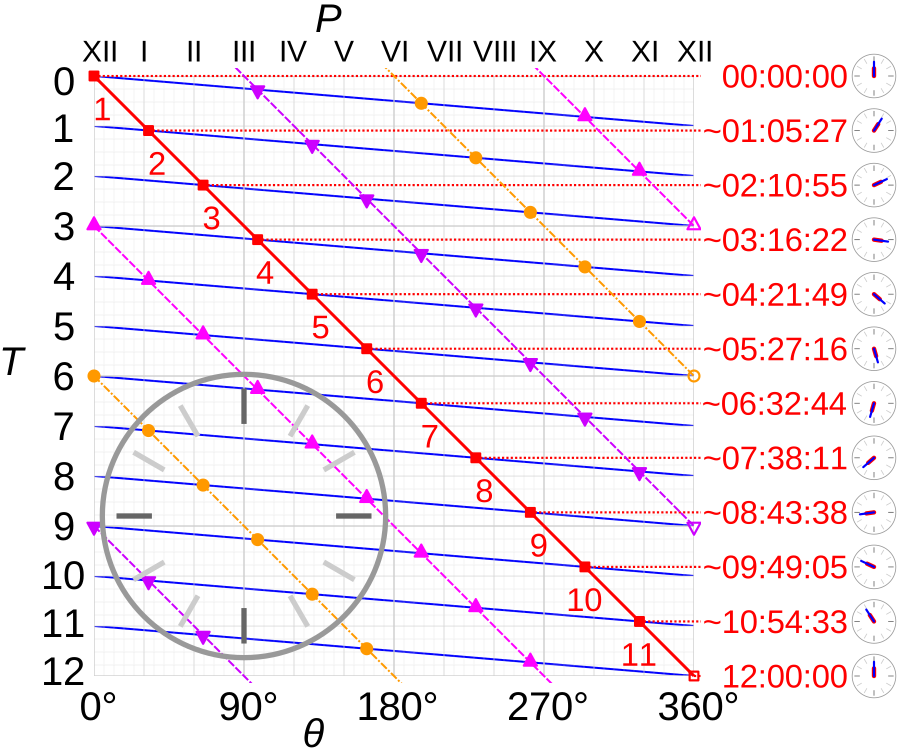
In this graphical solution, T denotes time in hours; P, hands' positions; and θ, hands' angles in degrees. The red (thick solid) line denotes the hour hand; the blue (thin solid) lines denote the minute hand. Their intersections (red squares) are when they align. Additionally, orange circles (dash-dot line) are when hands are in opposition, and pink triangles (dashed line) are when they are perpendicular. In the SVG file, hover over the graph to show positions of the hands on a clock face.
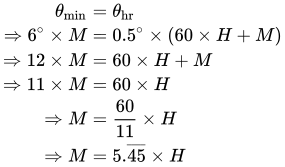
The hour and minute hands are superimposed only when their angle is the same.
H is an integer in the range 0–11. This gives times of: 0:00, 1:05.45, 2:10.90, 3:16.36, 4:21.81, 5:27.27. 6:32.72, 7:38.18, 8:43.63, 9:49.09,
10:54.54, and 12:00.
(0.45 minutes are exactly 27.27 seconds.)
Central angle Clock angle problem Decimal degrees Dihedral angle Exterior angle theorem Golden angle Great circle distance Horn angle Inscribed angle Irrational
observes the angle made by the intersection of the line of sight to the longitudinal axis, the dimension of length, of the vessel, using the clock analogy
90384°W / 31.44841; -104.90384 The Clock of the Long Now, also called the 10,000-year clock, is a mechanical clock under construction that is designed
using the angle of the sun. The people of Kush created sun dials through geometry. The Roman writer Vitruvius lists dials and shadow clocks known at that
A pendulum clock is a clock that uses a pendulum, a swinging weight, as its timekeeping element. The advantage of a pendulum for timekeeping is that it
relative to the resting frame of the clock (right part of diagram), the light pulse is seen as tracing out a longer, angled path 2D. Keeping the speed of light
an unsolved problem due to the difficulty in calculating longitude. Navigators could determine their latitude by measuring the sun's angle at noon (i.e
bearing or azimuth is the horizontal angle between the direction of an object and north or another object. The angle value can be specified in various angular