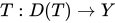
Let and be Banach spaces, a closed linear operator whose domain is dense in and the transpose of . The theorem asserts that the following conditions are equivalent:
Where and are the null space of and , respectively.
Note that there is always an inclusion , because if and , then . Likewise, there is an inclusion . So the non-trivial part of the above theorem is the opposite inclusion in the final two bullets.
Corollaries
edit
Several corollaries are immediate from the theorem. For instance, a densely defined closed operator as above has if and only if the transpose has a continuous inverse. Similarly, if and only if has a continuous inverse.
Sketch of proof
edit
Since the graph of T is closed, the proof reduces to the case when is a bounded operator between Banach spaces. Now, factors as . Dually, is
Now, if is closed, then it is Banach and so by the open mapping theorem, is a topological isomorphism. It follows that is an isomorphism and then . (More work is needed for the other implications.)
In mathematics, the closed graph theorem may refer to one of several basic results characterizing continuous functions in terms of their graphs. Each gives
Steinhaus said of Banach: "Banach was my greatest scientific discovery." Closed range theorem International Stefan Banach Prize List of Poles List of Polish mathematicians
In vector calculus, Green's theorem relates a line integral around a simple closed curve C to a double integral over the plane region D (surface in R 2
closed and bounded interval has a uniformly convergent subsequence. The main condition is the equicontinuity of the family of functions. The theorem is
Brouwer's theorem are for continuous functions f {\displaystyle f} from a closed interval I {\displaystyle I} in the real numbers to itself or from a closed disk