The Fradkin tensor, or Jauch-Hill-Fradkin tensor, named after Josef-Maria Jauch and Edward Lee Hill[1] and David M. Fradkin,[2] is a conservation law used in the treatment of the isotropic multidimensional harmonic oscillator in classical mechanics. For the treatment of the quantum harmonic oscillator in quantum mechanics, it is replaced by the tensor-valued Fradkin operator.
The Fradkin tensor provides enough conserved quantities to make the oscillator's equations of motion maximally superintegrable.[3] This implies that to determine the trajectory of the system, no differential equations need to be solved, only algebraic ones.
Similarly to the Laplace–Runge–Lenz vector in the Kepler problem, the Fradkin tensor arises from a hidden symmetry of the harmonic oscillator.
Definition
editSuppose the Hamiltonian of a harmonic oscillator is given by
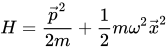
with
- momentum ,
- mass ,
- angular frequency , and
- displacement ,


then the Fradkin tensor (up to an arbitrary normalisation) is defined as

In particular, is given by the trace: . The Fradkin Tensor is a thus a symmetric matrix, and for an -dimensional harmonic oscillator has independent entries, for example 5 in 3 dimensions.


Properties
edit- The Fradkin tensor is orthogonal to the angular momentum :
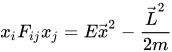
- contracting the Fradkin tensor with the displacement vector gives the relationship
- .
- The 5 independent components of the Fradkin tensor and the 3 components of angular momentum give the 8 generators of , the three-dimensional special unitary group in 3 dimensions, with the relationships



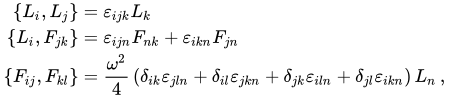
- where is the Poisson bracket, is the Kronecker delta, and is the Levi-Civita symbol.


Proof of conservation
editIn Hamiltonian mechanics, the time evolution of any function defined on phase space is given by

- ,

so for the Fradkin tensor of the harmonic oscillator,
- .

The Fradkin tensor is the conserved quantity associated to the transformation

Quantum mechanics
editIn quantum mechanics, position and momentum are replaced by the position- and momentum operators and the Poisson brackets by the commutator. As such the Hamiltonian becomes the Hamiltonian operator, angular momentum the angular momentum operator, and the Fradkin tensor the Fradkin operator. All of the above properties continue to hold after making these replacements.
References
edit- ^ Jauch, Josef-Maria; Hill, Edward Lee (1 April 1940). "On the Problem of Degeneracy in Quantum Mechanics". Physical Review. 57 (7): 641–645. Bibcode:1940PhRv...57..641J. doi:10.1103/PhysRev.57.641.
- ^ Fradkin, David M. (1 May 1967). "Existence of the Dynamic Symmetries and for All Classical Central Potential Problems". Progress of Theoretical Physics. 37 (5): 798–812. doi:10.1143/PTP.37.798.
- ^ Miller, W.; Post, S.; Winternitz, P. (2013). "Classical and quantum superintegrability with applications". J. Phys. A: Math. Theor. 46 (42) 423001. arXiv:1309.2694. Bibcode:2013JPhA...46P3001M. doi:10.1088/1751-8113/46/42/423001.
- ^ Lévy-Leblond, Jean-Marc (1 May 1971). "Conservation Laws for Gauge-Variant Lagrangians in Classical Mechanics". American Journal of Physics. 39 (5): 502–506. Bibcode:1971AmJPh..39..502L. doi:10.1119/1.1986202.


