In mathematics, an interleave sequence is obtained by merging two sequences via an in shuffle.

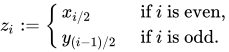
Let be a set, and let and , be two sequences in The interleave sequence is defined to be the sequence . Formally, it is the sequence given by

Properties

edit
  • The interleave sequence is convergent if and only if the sequences and are convergent and have the same limit.[1]
  • Consider two real numbers a and b greater than zero and smaller than 1. One can interleave the sequences of digits of a and b, which will determine a third number c, also greater than zero and smaller than 1. In this way one obtains an injection from the square (0, 1) × (0, 1) to the interval (0, 1). Different radixes give rise to different injections; the one for the binary numbers is called the Z-order curve or Morton code.[2]

References

edit
  1. ^ Strichartz, Robert S. (2000), The Way of Analysis, Jones & Bartlett Learning, p. 78, ISBN 9780763714970.
  2. ^ Mamoulis, Nikos (2012), Spatial Data Management, Synthesis lectures on data management, vol. 21, Morgan & Claypool Publishers, pp. 22–23, ISBN 9781608458325.

This article incorporates material from Interleave sequence on PlanetMath, which is licensed under the Creative Commons Attribution/Share-Alike License.

📚 Artikel Terkait di Wikipedia

Interleaving

Z-order (curve) for points Interleave sequence, a mathematical sequence formed by interleaving members of two other sequences in alternation This disambiguation

Machine code

the implementation of error tables in Microsoft's Altair BASIC, where interleaved instructions mutually shared their instruction bytes. The technique is

Faro shuffle

The analogous operation to an out-shuffle for an infinite sequence is the interleave sequence. For simplicity, we will use a deck of six cards. The following

Cross-interleaved Reed–Solomon coding

In the compact disc system, cross-interleaved Reed–Solomon code (CIRC) provides error detection and error correction. CIRC adds to every three data bytes

Sequence point

interleave sub-expressions across multiple parameters. Memory barrier Clause 6.5#2 of the C99 specification: "Between the previous and next sequence point

FASTA format

the FASTA format expect the sequence headers to be preceded by ">". The sequence is generally represented as "interleaved", or on multiple lines as in

Interleaving (disk storage)

then the next sector in sequence is ready to be read just as the computer is ready to do so. Matching the sector interleave to the processing speed therefore

List of UWB channels

channels, which simply interleave their data across two bands. Note that all TFCs will be in the same band at some time during their sequence. TFC numbering of