In the mathematical field of differential topology, the Lie bracket of vector fields, also known as the Jacobi–Lie bracket or the commutator of vector fields, is an operator that assigns to any two vector fields and on a smooth manifold a third vector field denoted .


![{\displaystyle [X,Y]}](https://wikimedia.org/api/rest_v1/media/math/render/svg/94470b44d283fde62130212956058ca6b727da37)
Conceptually, the Lie bracket is the derivative of along the flow generated by , and is sometimes denoted ("Lie derivative of Y along X"). This generalizes to the Lie derivative of any tensor field along the flow generated by .

The Lie bracket is an R-bilinear operation and turns the set of all smooth vector fields on the manifold into an (infinite-dimensional) Lie algebra.
The Lie bracket plays an important role in differential geometry and differential topology, for instance in the Frobenius integrability theorem, and is also fundamental in the geometric theory of nonlinear control systems.[1]
V. I. Arnold refers to this as the "fisherman derivative", as one can imagine being a fisherman, holding a fishing rod, sitting in a boat. Both the boat and the float are flowing according to vector field , and the fisherman lengthens/shrinks and turns the fishing rod according to vector field . The Lie bracket is the amount of dragging on the fishing float relative to the surrounding water.[2]
Definitions
editThere are three conceptually different but equivalent approaches to defining the Lie bracket:
Vector fields as derivations
editEach smooth vector field on a manifold may be regarded as a differential operator acting on smooth functions (where and of class ) when we define to be another function whose value at a point is the directional derivative of at in the direction . In this way, each smooth vector field becomes a derivation on . Furthermore, any derivation on arises from a unique smooth vector field .



In general, the commutator of any two derivations and is again a derivation, where denotes composition of operators. This can be used to define the Lie bracket as the vector field corresponding to the commutator derivation:



=X(Y(f))-Y(X(f))\;\;{\text{ for all }}f\in C^{\infty }(M).}](https://wikimedia.org/api/rest_v1/media/math/render/svg/c50da22759118038f21af5f53973105f004e0fcc)
Flows and limits
editLet be the flow associated with the vector field , and let denote the tangent map derivative operator. Then the Lie bracket of and at the point can be defined as the Lie derivative:


![{\displaystyle [X,Y]_{x}\ =\ ({\mathcal {L}}_{X}Y)_{x}\ :=\ \lim _{t\to 0}{\frac {(\mathrm {D} \Phi _{-t}^{X})Y_{\Phi _{t}^{X}(x)}\,-\,Y_{x}}{t}}\ =\ \left.{\tfrac {\mathrm {d} }{\mathrm {d} t}}\right|_{t=0}(\mathrm {D} \Phi _{-t}^{X})Y_{\Phi _{t}^{X}(x)}.}](https://wikimedia.org/api/rest_v1/media/math/render/svg/666fcfa4b50717c71c6880a71b793c89b0684c5b)
This also measures the failure of the flow in the successive directions to return to the point :


![{\displaystyle [X,Y]_{x}\ =\ \left.{\tfrac {1}{2}}{\tfrac {\mathrm {d} ^{2}}{\mathrm {d} t^{2}}}\right|_{t=0}(\Phi _{-t}^{Y}\circ \Phi _{-t}^{X}\circ \Phi _{t}^{Y}\circ \Phi _{t}^{X})(x)\ =\ \left.{\tfrac {\mathrm {d} }{\mathrm {d} t}}\right|_{t=0}(\Phi _{\!-{\sqrt {t}}}^{Y}\circ \Phi _{\!-{\sqrt {t}}}^{X}\circ \Phi _{\!{\sqrt {t}}}^{Y}\circ \Phi _{\!{\sqrt {t}}}^{X})(x).}](https://wikimedia.org/api/rest_v1/media/math/render/svg/e34f5564a0cf27b7ea5e18c6c39a7270c0faabd8)
In coordinates
editThough the above definitions of Lie bracket are intrinsic (independent of the choice of coordinates on the manifold ), in practice one often wants to compute the bracket in terms of a specific coordinate system . We write for the associated local basis of the tangent bundle, so that general vector fields can be written and for smooth functions . Then the Lie bracket can be computed as:


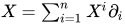


![{\displaystyle [X,Y]:=\sum _{i=1}^{n}\left(X(Y^{i})-Y(X^{i})\right)\partial _{i}=\sum _{i=1}^{n}\sum _{j=1}^{n}\left(X^{j}\partial _{j}Y^{i}-Y^{j}\partial _{j}X^{i}\right)\partial _{i}.}](https://wikimedia.org/api/rest_v1/media/math/render/svg/1e1d386cd12d6e5410f21e071728dfd9cc0f215b)
If is (an open subset of) , then the vector fields and can be written as smooth maps of the form and , and the Lie bracket is given by:



![{\displaystyle [X,Y]:M\to \mathbb {R} ^{n}}](https://wikimedia.org/api/rest_v1/media/math/render/svg/1cd9a06081bb7fccd74da9e43dbca1ca86e63d07)
![{\displaystyle [X,Y]:=J_{Y}X-J_{X}Y}](https://wikimedia.org/api/rest_v1/media/math/render/svg/b9ad49dd7a8f4655150a8f4bd87be85368684b3c)
where and are Jacobian matrices ( and respectively using index notation) multiplying the column vectors and .


Properties
editThe Lie bracket of vector fields equips the real vector space of all vector fields on (i.e., smooth sections of the tangent bundle ) with the structure of a Lie algebra, which means [ • , • ] is a map with:


- R-bilinearity
- Anti-symmetry,
- Jacobi identity,
![{\displaystyle [X,Y]=-[Y,X]}](https://wikimedia.org/api/rest_v1/media/math/render/svg/8c433e248c0c7e659ef3f2d9df64d8c7505630bc)
![{\displaystyle [X,[Y,Z]]+[Z,[X,Y]]+[Y,[Z,X]]=0.}](https://wikimedia.org/api/rest_v1/media/math/render/svg/7ad997ac835b15728cc9830bf24b0adf54d80403)
An immediate consequence of the second property is that for any .
![{\displaystyle [X,X]=0}](https://wikimedia.org/api/rest_v1/media/math/render/svg/b96f040cce00a009ddf39e12baa062abfdcdb8b8)
Furthermore, there is a "product rule" for Lie brackets. Given a smooth (scalar-valued) function on and a vector field on , we get a new vector field by multiplying the vector by the scalar at each point . Then:


![{\displaystyle [X,fY]\ =\ X\!(f)\,Y\,+\,f\,[X,Y],}](https://wikimedia.org/api/rest_v1/media/math/render/svg/1a1eb7a6229a42f8e512d960fea41170229685ed)
where we multiply the scalar function with the vector field , and the scalar function with the vector field . This turns the vector fields with the Lie bracket into a Lie algebroid.
Vanishing of the Lie bracket of and means that following the flows in these directions defines a surface embedded in , with and as coordinate vector fields:
Theorem: iff the flows of and commute locally, meaning for all and sufficiently small , .
![{\displaystyle [X,Y]=0\,}](https://wikimedia.org/api/rest_v1/media/math/render/svg/36c8211df4720629ec640fba8f45cfc43378b9e4)


This is a special case of the Frobenius integrability theorem.
Examples
editFor a Lie group , the corresponding Lie algebra is the tangent space at the identity , which can be identified with the vector space of left invariant vector fields on . The Lie bracket of two left invariant vector fields is also left invariant, which defines the Jacobi–Lie bracket operation .


![{\displaystyle [\,\cdot \,,\,\cdot \,]:{\mathfrak {g}}\times {\mathfrak {g}}\to {\mathfrak {g}}}](https://wikimedia.org/api/rest_v1/media/math/render/svg/9a7d235ea0a4e57e99f083d4822eafcec80df29d)
For a matrix Lie group, whose elements are matrices , each tangent space can be represented as matrices: , where means matrix multiplication and is the identity matrix. The invariant vector field corresponding to is given by , and a computation shows the Lie bracket on corresponds to the usual commutator of matrices:





![{\displaystyle [X,Y]\ =\ X\cdot Y-Y\cdot X.}](https://wikimedia.org/api/rest_v1/media/math/render/svg/a722a7be9da68d38d987b848a52d7c3cbd963429)
Generalizations
editAs mentioned above, the Lie derivative can be seen as a generalization of the Lie bracket. Another generalization of the Lie bracket (to vector-valued differential forms) is the Frölicher–Nijenhuis bracket.
References
edit- ^ Isaiah 2009, pp. 20–21, nonholonomic systems; Khalil 2002, pp. 523–530, feedback linearization.
- ^ Arnolʹd, V. I.; Khesin, Boris A. (1999). Topological methods in hydrodynamics. Applied mathematical sciences (Corr. 2. printing ed.). New York Berlin Heidelberg: Springer. p. 6. ISBN 978-0-387-94947-5.
- "Lie bracket", Encyclopedia of Mathematics, EMS Press, 2001 [1994]
- Isaiah, Pantelis (2009), "Controlled parking [Ask the experts]", IEEE Control Systems Magazine, 29 (3): 17–21, 132, doi:10.1109/MCS.2009.932394, S2CID 42908664
- Khalil, H.K. (2002), Nonlinear Systems (3rd ed.), Upper Saddle River, NJ: Prentice Hall, ISBN 0-13-067389-7
- Kolář, I., Michor, P., and Slovák, J. (1993), Natural operations in differential geometry, Berlin, Heidelberg, New York: Springer-Verlag, ISBN 3-540-56235-4
{{citation}}: CS1 maint: multiple names: authors list (link) Extensive discussion of Lie brackets, and the general theory of Lie derivatives. - Lang, S. (1995), Differential and Riemannian manifolds, Springer-Verlag, ISBN 978-0-387-94338-1 For generalizations to infinite dimensions.
- Warner, Frank (1983) [1971], Foundations of differentiable manifolds and Lie groups, New York-Berlin: Springer-Verlag, ISBN 0-387-90894-3
