In mathematics, the term linear function refers to two distinct but related notions:[1]
- In calculus and related areas, a linear function is a function whose graph is a straight line, that is, a polynomial function of degree zero (a constant polynomial) or one (a linear polynomial).[2] For distinguishing such a linear function from the other concept, the term affine function is often used.[3]
- In linear algebra, mathematical analysis,[4] and functional analysis, a linear function is a kind of function between vector spaces.[5]
As a polynomial function
edit
In calculus, analytic geometry and related areas, a linear function is a polynomial of degree one or less, including the zero polynomial. (The latter is a polynomial with no terms, and it is not considered to have degree zero.)
When the function is of only one variable, it is of the form

where a and b are constants, often real numbers. The graph of such a function of one variable is a nonvertical line. a is frequently referred to as the slope of the line, and b as the intercept.
If a > 0 then the gradient is positive and the graph slopes upwards.
If a < 0 then the gradient is negative and the graph slopes downwards.
For a function of any finite number of variables, the general formula is
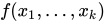

and the graph is a hyperplane of dimension k.
A constant function is also considered linear in this context, as it is a polynomial of degree zero or is the zero polynomial. Its graph, when there is only one variable, is a horizontal line.
In this context, a function that is also a linear map (the other meaning of linear functions, see the below) may be referred to as a homogeneous linear function or a linear form. In the context of linear algebra, the polynomial functions of degree 0 or 1 are the scalar-valued affine maps.
As a linear map
edit
In linear algebra, a linear function is a map from a vector space to a vector space (Both spaces are not necessarily different.) over a same field K such that



Here a denotes a constant belonging to the field K of scalars (for example, the real numbers), and x and y are elements of , which might be K itself. Even if the same symbol is used, the operation of addition between x and y (belonging to ) is not necessarily same to the operation of addition between and (belonging to ).


In other terms the linear function preserves vector addition and scalar multiplication.
Some authors use "linear function" only for linear maps that take values in the scalar field;[6] these are more commonly called linear forms.
The "linear functions" of calculus qualify as "linear maps" when (and only when) f(0, ..., 0) = 0, or, equivalently, when the constant b equals zero in the one-degree polynomial above. Geometrically, the graph of the function must pass through the origin.
See also
edit- Homogeneous function
- Nonlinear system
- Piecewise linear function
- Linear approximation
- Linear interpolation
- Discontinuous linear map
- Linear least squares
Notes
edit- ^ "The term linear function means a linear form in some textbooks and an affine function in others." Vaserstein 2006, p. 50-1
- ^ Stewart 2012, p. 23
- ^ A. Kurosh (1975). Higher Algebra. Mir Publishers. p. 214.
- ^ T. M. Apostol (1981). Mathematical Analysis. Addison-Wesley. p. 345.
- ^ Shores 2007, p. 71
- ^ Gelfand 1961
References
edit- Izrail Moiseevich Gelfand (1961), Lectures on Linear Algebra, Interscience Publishers, Inc., New York. Reprinted by Dover, 1989. ISBN 0-486-66082-6
- Shores, Thomas S. (2007). Applied Linear Algebra and Matrix Analysis. Undergraduate Texts in Mathematics. Springer. ISBN 978-0-387-33195-9.
- Stewart, James (2012). Calculus: Early Transcendentals (7E ed.). Brooks/Cole. ISBN 978-0-538-49790-9.
- Leonid N. Vaserstein (2006), "Linear Programming", in Leslie Hogben, ed., Handbook of Linear Algebra, Discrete Mathematics and Its Applications, Chapman and Hall/CRC, chap. 50. ISBN 1-584-88510-6
