In algebra, a module homomorphism is a function between modules that preserves the module structures. Explicitly, if M and N are left modules over a ring R, then a function is called an R-module homomorphism or an R-linear map if for any x, y in M and r in R,



In other words, f is a group homomorphism (for the underlying additive groups) that commutes with scalar multiplication. If M, N are right R-modules, then the second condition is replaced with

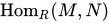
The preimage of the zero element under f is called the kernel of f. The set of all module homomorphisms from M to N is denoted by . It is an abelian group (under pointwise addition) but is not necessarily a module unless R is commutative.
The composition of module homomorphisms is again a module homomorphism, and the identity map on a module is a module homomorphism. Thus, all the (say left) modules together with all the module homomorphisms between them form the category of modules.
Terminology
editA module homomorphism is called a module isomorphism if it admits an inverse homomorphism; in particular, it is a bijection. Conversely, one can show a bijective module homomorphism is an isomorphism; i.e., the inverse is a module homomorphism. In particular, a module homomorphism is an isomorphism if and only if it is an isomorphism between the underlying abelian groups.
The isomorphism theorems hold for module homomorphisms.
A module homomorphism from a module M to itself is called an endomorphism and an isomorphism from M to itself an automorphism. One writes for the set of all endomorphisms of a module M. It is not only an abelian group but is also a ring with multiplication given by function composition, called the endomorphism ring of M. The group of units of this ring is the automorphism group of M.

Schur's lemma says that a homomorphism between simple modules (modules with no non-trivial submodules) must be either zero or an isomorphism. In particular, the endomorphism ring of a simple module is a division ring.
In the language of the category theory, an injective homomorphism is also called a monomorphism and a surjective homomorphism an epimorphism.
Examples
edit- The zero map M → N that maps every element to zero.
- A linear transformation between vector spaces.
- .
- For a commutative ring R and ideals I, J, there is the canonical identification


- given by . In particular, is the annihilator of I.


- Given a ring R and an element r, let denote the left multiplication by r. Then for any s, t in R,
- .


- That is, is right R-linear.

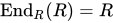
- For any ring R,
- as rings when R is viewed as a right module over itself. Explicitly, this isomorphism is given by the left regular representation .
- Similarly, as rings when R is viewed as a left module over itself. Textbooks or other references usually specify which convention is used.
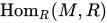
- through for any left module M.[1] (The module structure on Hom here comes from the right R-action on R; see #Module structures on Hom below.)
- is called the dual module of M; it is a left (resp. right) module if M is a right (resp. left) module over R with the module structure coming from the R-action on R. It is denoted by .
- Given a ring homomorphism R → S of commutative rings and an S-module M, an R-linear map θ: S → M is called a derivation if for any f, g in S, θ(f g) = f θ(g) + θ(f) g.
- If S, T are unital associative algebras over a ring R, then an algebra homomorphism from S to T is a ring homomorphism that is also an R-module homomorphism.




Module structures on Hom
editIn short, Hom inherits a ring action that was not used up to form Hom. More precise, let M, N be left R-modules. Suppose M has a right action of a ring S that commutes with the R-action; i.e., M is an (R, S)-module. Then
has the structure of a left S-module defined by: for s in S and x in M,

It is well-defined (i.e., is R-linear) since


and is a ring action since
- .

Note: the above verification would "fail" if one used the left R-action in place of the right S-action. In this sense, Hom is often said to "use up" the R-action.
Similarly, if M is a left R-module and N is an (R, S)-module, then is a right S-module by .

A matrix representation
editThe relationship between matrices and linear transformations in linear algebra generalizes in a natural way to module homomorphisms between free modules. Precisely, given a right R-module U, there is the canonical isomorphism of the abelian groups
![{\displaystyle \operatorname {Hom} _{R}(U^{\oplus n},U^{\oplus m}){\overset {f\mapsto [f_{ij}]}{\underset {\sim }{\to }}}M_{m,n}(\operatorname {End} _{R}(U))}](https://wikimedia.org/api/rest_v1/media/math/render/svg/bb5bf64d8509dd8aa9edca8f6d1e115e15bdd81f)
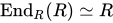
obtained by viewing consisting of column vectors and then writing f as an m × n matrix. In particular, viewing R as a right R-module and using , one has

- ,

which turns out to be a ring isomorphism (as a composition corresponds to a matrix multiplication).
Note the above isomorphism is canonical; no choice is involved. On the other hand, if one is given a module homomorphism between finite-rank free modules, then a choice of an ordered basis corresponds to a choice of an isomorphism . The above procedure then gives the matrix representation with respect to such choices of the bases. For more general modules, matrix representations may either lack uniqueness or not exist.

Defining
editIn practice, one often defines a module homomorphism by specifying its values on a generating set. More precisely, let M and N be left R-modules. Suppose a subset S generates M; i.e., there is a surjection with a free module F with a basis indexed by S and kernel K (i.e., one has a free presentation). Then to give a module homomorphism is to give a module homomorphism that kills K (i.e., maps K to zero).


Operations
editIf and are module homomorphisms, then their direct sum is
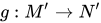

and their tensor product is

Let be a module homomorphism between left modules. The graph Γf of f is the submodule of M ⊕ N given by
- ,

which is the image of the module homomorphism M → M ⊕ N, x → (x, f(x)), called the graph morphism.
The transpose of f is

If f is an isomorphism, then the transpose of the inverse of f is called the contragredient of f.
Exact sequences
editConsider a sequence of module homomorphisms

Such a sequence is called a chain complex (or often just complex) if each composition is zero; i.e., or equivalently the image of is contained in the kernel of . (If the numbers increase instead of decrease, then it is called a cochain complex; e.g., de Rham complex.) A chain complex is called an exact sequence if . A special case of an exact sequence is a short exact sequence:




where is injective, the kernel of is the image of and is surjective.


Any module homomorphism defines an exact sequence

where is the kernel of , and is the cokernel, that is the quotient of by the image of .


In the case of modules over a commutative ring, a sequence is exact if and only if it is exact at all the maximal ideals; that is all sequences

are exact, where the subscript means the localization at a maximal ideal .

If are module homomorphisms, then they are said to form a fiber square (or pullback square), denoted by M ×B N, if it fits into


where .

Example: Let be commutative rings, and let I be the annihilator of the quotient B-module A/B (which is an ideal of A). Then canonical maps form a fiber square with



Endomorphisms of finitely generated modules
editLet be an endomorphism between finitely generated R-modules for a commutative ring R. Then

- is killed by its characteristic polynomial relative to the generators of M; see Nakayama's lemma#Proof.
- If is surjective, then it is injective.[2]

See also: Herbrand quotient (which can be defined for any endomorphism with some finiteness conditions.)
Variant: additive relations
editAn additive relation from a module M to a module N is a submodule of [3] In other words, it is a "many-valued" homomorphism defined on some submodule of M. The inverse of f is the submodule . Any additive relation f determines a homomorphism from a submodule of M to a quotient of N




where consists of all elements x in M such that (x, y) belongs to f for some y in N.

A transgression that arises from a spectral sequence is an example of an additive relation.
See also
editNotes
edit- ^ Bourbaki, Nicolas (1998), "Chapter II, §1.14, remark 2", Algebra I, Chapters 1–3, Elements of Mathematics, Springer-Verlag, ISBN 3-540-64243-9, MR 1727844
- ^ Matsumura, Hideyuki (1989), "Theorem 2.4", Commutative Ring Theory, Cambridge Studies in Advanced Mathematics, vol. 8 (2nd ed.), Cambridge University Press, ISBN 0-521-36764-6, MR 1011461
- ^ Mac Lane, Saunders (1995), Homology, Classics in Mathematics, Springer-Verlag, p. 52, ISBN 3-540-58662-8, MR 1344215
