The Newmark-beta method is a method of numerical integration used to solve certain differential equations. It is widely used in numerical evaluation of the dynamic response of structures and solids such as in finite element analysis to model dynamic systems. The method is named after Nathan M. Newmark,[1] former Professor of Civil Engineering at the University of Illinois at Urbana–Champaign, who developed it in 1959 for use in structural dynamics. The semi-discretized structural equation is a second order ordinary differential equation system,

here  is the mass matrix,
  is the damping matrix,
  and
and  are internal force per unit displacement and external forces, respectively.
Using the extended mean value theorem, the Newmark- method states that the first time derivative (velocity in the equation of motion) can be solved as,

where

therefore

Because acceleration also varies with time, however, the extended mean value theorem must also be extended to the second time derivative to obtain the correct displacement. Thus,

where again

The discretized structural equation becomes
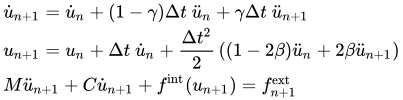
Explicit central difference scheme is obtained by setting  and
and 
Average constant acceleration (Middle point rule) is obtained by setting and 
Stability Analysis
edit
A time-integration scheme is said to be stable if there exists an integration time-step  so that for any
 ![{\displaystyle \Delta t\in (0,\Delta t_{0}]}](https://wikimedia.org/api/rest_v1/media/math/render/svg/df67e9111ff80516982b03fda5177a56fc97fdf6) , a finite variation of the state vector
, a finite variation of the state vector  at time
  induces only a non-increasing variation of the state-vector
  calculated at a subsequent time
  . Assume the time-integration scheme is

The linear stability is equivalent to 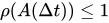 , here
  is the spectral radius of the update matrix
  .
.
For the linear structural equation

here  is the stiffness matrix. Let
 ![{\displaystyle q_{n}=[{\dot {u}}_{n},u_{n}]}](https://wikimedia.org/api/rest_v1/media/math/render/svg/05100e63ed46816310a303412fa2ed1c45f504e6) , the update matrix is
, the update matrix is  , and
, and

For undamped case ( ), the update matrix can be decoupled by introducing the eigenmodes
  of the structural system, which are solved by the generalized eigenvalue problem
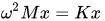
For each eigenmode, the update matrix becomes

The characteristic equation of the update matrix is

As for the stability, we have
Explicit central difference scheme ( and ) is stable when  .
.
Average constant acceleration (Middle point rule) ( and ) is unconditionally stable.
References
edit
