Paraboloidal coordinates are three-dimensional orthogonal coordinates that generalize two-dimensional parabolic coordinates. They possess elliptic paraboloids as one-coordinate surfaces. As such, they should be distinguished from parabolic cylindrical coordinates and parabolic rotational coordinates, both of which are also generalizations of two-dimensional parabolic coordinates. The coordinate surfaces of the former are parabolic cylinders, and the coordinate surfaces of the latter are circular paraboloids.
Differently from cylindrical and rotational parabolic coordinates, but similarly to the related ellipsoidal coordinates, the coordinate surfaces of the paraboloidal coordinate system are not produced by rotating or projecting any two-dimensional orthogonal coordinate system.
Common differential operators can be expressed in the coordinates by substituting the scale factors into the general formulas for these operators, which are applicable to any three-dimensional orthogonal coordinates. For instance, the gradient operator is
Paraboloidal coordinates can be useful for solving certain partial differential equations. For instance, the Laplace equation and Helmholtz equation are both separable in paraboloidal coordinates. Hence, the coordinates can be used to solve these equations in geometries with paraboloidal symmetry, i.e. with boundary conditions specified on sections of paraboloids.
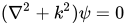
The Helmholtz equation is . Taking , the separated equations are[3]
where and are the two separation constants. Similarly, the separated equations for the Laplace equation can be obtained by setting in the above.
Each of the separated equations can be cast in the form of the Baer equation. Direct solution of the equations is difficult, however, in part because the separation constants and appear simultaneously in all three equations.
Following the above approach, paraboloidal coordinates have been used to solve for the electric field surrounding a conducting paraboloid.[4]
References
edit
^Yoon, LCLY; M, Willatzen (2011), Separable Boundary-Value Problems in Physics, Wiley-VCH, p. 217, ISBN978-3-527-63492-7
Arfken G (1970). Mathematical Methods for Physicists (2nd ed.). Orlando, FL: Academic Press. pp. 119–120.
Sauer R, Szabó I (1967). Mathematische Hilfsmittel des Ingenieurs. New York: Springer Verlag. p. 98. LCCN67025285.
Zwillinger D (1992). Handbook of Integration. Boston, MA: Jones and Bartlett. p. 114. ISBN0-86720-293-9. Same as Morse & Feshbach (1953), substituting uk for ξk.
Moon P, Spencer DE (1988). "Paraboloidal Coordinates (μ, ν, λ)". Field Theory Handbook, Including Coordinate Systems, Differential Equations, and Their Solutions (corrected 2nd ed., 3rd print ed.). New York: Springer-Verlag. pp. 44–48 (Table 1.11). ISBN978-0-387-18430-2.
geometry, a coordinate system is a system that uses one or more numbers, or coordinates, to uniquely determine and standardize the position of the points or
In mathematics, orthogonal coordinates are defined as a set of d coordinates q = ( q 1 , q 2 , … , q d ) {\displaystyle \mathbf {q} =(q^{1},q^{2},\dots
A parabolic (or paraboloid or paraboloidal) reflector (or dish or mirror) is a reflective surface used to collect or project energy such as light, sound
Laboratories in 1961. It consists of a flaring metal horn with a metal paraboloidal reflector mounted in the mouth at a 45° angle. The advantage of this
the propagation of electromagnetic waves (light) in the form of either paraboloidal waves or Gaussian beams. Most lasers emit beams that take this form.
surface, so observers in different places see different analemmas. The paraboloidal dishes that are used for radio communication with geosynchronous satellites







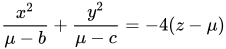

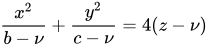

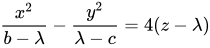
![{\displaystyle h_{\mu }=\left[{\frac {\left(\mu -\nu \right)\left(\mu -\lambda \right)}{\left(\mu -b\right)\left(\mu -c\right)}}\right]^{1/2}}](https://wikimedia.org/api/rest_v1/media/math/render/svg/eaccb1084eddd2db984cf0b052ff7884a4b152b8)
![{\displaystyle h_{\nu }=\left[{\frac {\left(\mu -\nu \right)\left(\lambda -\nu \right)}{\left(b-\nu \right)\left(c-\nu \right)}}\right]^{1/2}}](https://wikimedia.org/api/rest_v1/media/math/render/svg/11790f76f35a6ab2b867f3b6729f669170c7ac23)
![{\displaystyle h_{\lambda }=\left[{\frac {\left(\lambda -\nu \right)\left(\mu -\lambda \right)}{\left(b-\lambda \right)\left(\lambda -c\right)}}\right]^{1/2}}](https://wikimedia.org/api/rest_v1/media/math/render/svg/39eeb3023b903672606255a46487a7bc90d475f4)
![{\displaystyle dV={\frac {(\mu -\nu )(\mu -\lambda )(\lambda -\nu )}{\left[(\mu -b)(\mu -c)(b-\nu )(c-\nu )(b-\lambda )(\lambda -c)\right]^{1/2}}}\ d\lambda d\mu d\nu }](https://wikimedia.org/api/rest_v1/media/math/render/svg/066e18ddd5cb9b5c58b4fa3dff4f30be027a0e79)
![{\displaystyle \nabla =\left[{\frac {\left(\mu -b\right)\left(\mu -c\right)}{\left(\mu -\nu \right)\left(\mu -\lambda \right)}}\right]^{1/2}\mathbf {e} _{\mu }{\frac {\partial }{\partial \mu }}+\left[{\frac {\left(b-\nu \right)\left(c-\nu \right)}{\left(\mu -\nu \right)\left(\lambda -\nu \right)}}\right]^{1/2}\mathbf {e} _{\nu }{\frac {\partial }{\partial \nu }}+\left[{\frac {\left(b-\lambda \right)\left(\lambda -c\right)}{\left(\lambda -\nu \right)\left(\mu -\lambda \right)}}\right]^{1/2}\mathbf {e} _{\lambda }{\frac {\partial }{\partial \lambda }}}](https://wikimedia.org/api/rest_v1/media/math/render/svg/ec6410a2adddb953e04da4b3aff0ccfbbc1f13ff)
![{\displaystyle {\begin{aligned}\nabla ^{2}=&\left[{\frac {\left(\mu -b\right)\left(\mu -c\right)}{\left(\mu -\nu \right)\left(\mu -\lambda \right)}}\right]^{1/2}{\frac {\partial }{\partial \mu }}\left[(\mu -b)^{1/2}(\mu -c)^{1/2}{\frac {\partial }{\partial \mu }}\right]\\&+\left[{\frac {\left(b-\nu \right)\left(c-\nu \right)}{\left(\mu -\nu \right)\left(\lambda -\nu \right)}}\right]^{1/2}{\frac {\partial }{\partial \nu }}\left[(b-\nu )^{1/2}(c-\nu )^{1/2}{\frac {\partial }{\partial \nu }}\right]\\&+\left[{\frac {\left(b-\lambda \right)\left(\lambda -c\right)}{\left(\lambda -\nu \right)\left(\mu -\lambda \right)}}\right]^{1/2}{\frac {\partial }{\partial \lambda }}\left[(b-\lambda )^{1/2}(\lambda -c)^{1/2}{\frac {\partial }{\partial \lambda }}\right]\end{aligned}}}](https://wikimedia.org/api/rest_v1/media/math/render/svg/f95e090fef3dd36493eaa9d354a25b85a8159228)

![{\displaystyle {\begin{aligned}&(\mu -b)(\mu -c){\frac {d^{2}M}{d\mu ^{2}}}+{\frac {1}{2}}\left[2\mu -(b+c)\right]{\frac {dM}{d\mu }}+\left[k^{2}\mu ^{2}+\alpha _{3}\mu -\alpha _{2}\right]M=0\\&(b-\nu )(c-\nu ){\frac {d^{2}N}{d\nu ^{2}}}+{\frac {1}{2}}\left[2\nu -(b+c)\right]{\frac {dN}{d\nu }}+\left[k^{2}\nu ^{2}+\alpha _{3}\nu -\alpha _{2}\right]N=0\\&(b-\lambda )(\lambda -c){\frac {d^{2}\Lambda }{d\lambda ^{2}}}-{\frac {1}{2}}\left[2\lambda -(b+c)\right]{\frac {d\Lambda }{d\lambda }}-\left[k^{2}\lambda ^{2}+\alpha _{3}\lambda -\alpha _{2}\right]\Lambda =0\\\end{aligned}}}](https://wikimedia.org/api/rest_v1/media/math/render/svg/e3b8c185588e8144f23a48b138a5673c4ccbb85b)


