This article includes a list of references, related reading, or external links, but its sources remain unclear because it lacks inline citations. (May 2024) |
In mathematics, infinitary combinatorics, or combinatorial set theory, is an extension of ideas in combinatorics to infinite sets. Some of the things studied include continuous graphs and trees, extensions of Ramsey's theorem, and Martin's axiom. Recent developments concern combinatorics of the continuum[1] and combinatorics on successors of singular cardinals.[2]
Ramsey theory for infinite sets
editWrite for ordinals, for a cardinal number (finite or infinite) and for a natural number. Erdős & Rado (1956) introduced the notation


as a shorthand way of saying that every partition of the set of -element subsets of into pieces has a homogeneous set of order type . A homogeneous set is in this case a subset of such that every -element subset is in the same element of the partition. When is 2 it is often omitted. Such statements are known as partition relations.
![{\displaystyle [\kappa ]^{n}}](https://wikimedia.org/api/rest_v1/media/math/render/svg/42a0aed1677d3f1b24aa70e6ad61037210d50ba8)


Assuming the axiom of choice, there are no ordinals with , so is usually taken to be finite. An extension where is almost allowed to be infinite is the notation


which is a shorthand way of saying that every partition of the set of finite subsets of into pieces has a subset of order type such that for any finite , all subsets of size are in the same element of the partition. When is 2 it is often omitted.
Another variation is the notation

which is a shorthand way of saying that every coloring of the set of -element subsets of with 2 colors has a subset of order type such that all elements of have the first color, or a subset of order type such that all elements of have the second color. A coloring of is a function .
![{\displaystyle [\lambda ]^{n}}](https://wikimedia.org/api/rest_v1/media/math/render/svg/77f4fdb80e903fd56ed442cf20907d757ac29423)

![{\displaystyle [\mu ]^{n}}](https://wikimedia.org/api/rest_v1/media/math/render/svg/1d7f9c923824753faef440b78b0816cc4069d9a6)
![{\displaystyle f:[\kappa ]^{n}\rightarrow p}](https://wikimedia.org/api/rest_v1/media/math/render/svg/598682a44d3563100fab36423a3ad5faa2d0e543)
Some properties of this include: (in what follows is a cardinal)


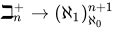


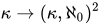
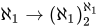
In choiceless universes, partition properties with infinite exponents may hold, and some of them are obtained as consequences of the axiom of determinacy (AD). For example, Donald A. Martin proved that AD implies
Strong colorings
editWacław Sierpiński showed that the Ramsey theorem does not extend to sets of size by showing that . That is, Sierpiński constructed a coloring of pairs of real numbers into two colors such that for every uncountable subset of real numbers , takes both colors. Taking any set of real numbers of size and applying the coloring of Sierpiński to it, we get that . Colorings such as this are known as strong colorings[3] and studied in set theory. Erdős, Hajnal & Rado (1965) introduced a similar notation as above for this.


![{\displaystyle [X]^{2}}](https://wikimedia.org/api/rest_v1/media/math/render/svg/bde891d2facb49a7ba0c0ab91082074137692b35)

Write for ordinals, for a cardinal number (finite or infinite) and for a natural number. Then
![{\displaystyle \displaystyle \kappa \nrightarrow [\lambda ]_{m}^{n}}](https://wikimedia.org/api/rest_v1/media/math/render/svg/ef582d5396054179b1d1e38fac1c5a24c8fdf392)
is a shorthand way of saying that there exists a coloring of the set of -element subsets of into pieces such that every set of order type is a rainbow set. A rainbow set is in this case a subset of such that takes all colors. When is 2 it is often omitted. Such statements are known as negative square bracket partition relations.

![{\displaystyle [A]^{n}}](https://wikimedia.org/api/rest_v1/media/math/render/svg/c4e9c84a12e6f13d336de3ba9f8634500033f162)
Another variation is the notation
![{\displaystyle \kappa \nrightarrow [\lambda ;\mu ]_{m}^{2}}](https://wikimedia.org/api/rest_v1/media/math/render/svg/50904feef791286e0814a750092e95cb7a651a19)
which is a shorthand way of saying that there exists a coloring of the set of 2-element subsets of with colors such that for every subset of order type and every subset of order type , the set takes all colors.
![{\displaystyle [\kappa ]^{2}}](https://wikimedia.org/api/rest_v1/media/math/render/svg/144a0e17127cf2f715bb901a7b31dc33c2a1208b)


Some properties of this include: (in what follows is a cardinal)
![{\displaystyle \displaystyle 2^{\kappa }\nrightarrow [\kappa ^{+}]^{2}}](https://wikimedia.org/api/rest_v1/media/math/render/svg/08134672050ffeed92707f0c96e407d0452b3516)
![{\displaystyle \displaystyle \aleph _{1}\nrightarrow [\aleph _{1}]^{2}}](https://wikimedia.org/api/rest_v1/media/math/render/svg/e3707146af77544a7f1ff8f8d4523f2f94b2cc33)
![{\displaystyle \displaystyle \aleph _{1}\nrightarrow [\aleph _{1}]_{3}^{2}}](https://wikimedia.org/api/rest_v1/media/math/render/svg/431a655b5dfa3455706e7b09acf144f503c18dc6)
![{\displaystyle \displaystyle \aleph _{1}\nrightarrow [\aleph _{1}]_{4}^{2}}](https://wikimedia.org/api/rest_v1/media/math/render/svg/50b35d95134623734b7fd0729e448258d03fd379)
![{\displaystyle \displaystyle \aleph _{1}\nrightarrow [\aleph _{1}]_{\aleph _{1}}^{2}}](https://wikimedia.org/api/rest_v1/media/math/render/svg/f165ee6e3c5278b98eed9bed2fd7a9f6f7cd556d)
![{\displaystyle \displaystyle \aleph _{1}\nrightarrow [\aleph _{1};\aleph _{1}]_{\aleph _{1}}^{2}}](https://wikimedia.org/api/rest_v1/media/math/render/svg/ab7d9064c46dcf299041e084f389d8ff93ba89ae)
![{\displaystyle \displaystyle 2^{\aleph _{0}}\nrightarrow [2^{\aleph _{0}}]_{\aleph _{0}}^{2}}](https://wikimedia.org/api/rest_v1/media/math/render/svg/287852519da52d6ac06263c7344d00d2381ae67f)
Large cardinals
editSeveral large cardinal properties can be defined using this notation. In particular:
- Weakly compact cardinals are those that satisfy
- α-Erdős cardinals are the smallest that satisfy
- Ramsey cardinals are those that satisfy


Notes
edit- ^ Andreas Blass, Combinatorial Cardinal Characteristics of the Continuum, Chapter 6 in Handbook of Set Theory, edited by Matthew Foreman and Akihiro Kanamori, Springer, 2010
- ^ Todd Eisworth, Successors of Singular Cardinals Chapter 15 in Handbook of Set Theory, edited by Matthew Foreman and Akihiro Kanamori, Springer, 2010
- ^ Rinot, Assaf, Tutorial on strong colorings and their applications, 6th European Set Theory Conference, retrieved 2023-12-10
References
edit- Dushnik, Ben; Miller, E. W. (1941), "Partially ordered sets", American Journal of Mathematics, 63 (3): 600–610, doi:10.2307/2371374, hdl:10338.dmlcz/100377, ISSN 0002-9327, JSTOR 2371374, MR 0004862
- Erdős, Paul; Hajnal, András; Rado, Richard (1965), "Partition relations for cardinal numbers", Acta Math. Acad. Sci. Hung., 16 (1–2): 93–196, doi:10.1007/BF01886396, MR 0202613
- Erdős, Paul; Hajnal, András (1971), "Unsolved problems in set theory", Axiomatic Set Theory ( Univ. California, Los Angeles, Calif., 1967), Proc. Sympos. Pure Math, vol. XIII Part I, Providence, R.I.: Amer. Math. Soc., pp. 17–48, MR 0280381
- Erdős, Paul; Hajnal, András; Máté, Attila; Rado, Richard (1984), Combinatorial set theory: partition relations for cardinals, Studies in Logic and the Foundations of Mathematics, vol. 106, Amsterdam: North-Holland Publishing Co., ISBN 0-444-86157-2, MR 0795592
- Erdős, P.; Rado, R. (1956), "A partition calculus in set theory" (PDF), Bull. Amer. Math. Soc., 62 (5): 427–489, doi:10.1090/S0002-9904-1956-10036-0, MR 0081864
- Kanamori, Akihiro (2000), The Higher Infinite (second ed.), Springer, ISBN 3-540-00384-3
- Kunen, Kenneth (1980), Set Theory: An Introduction to Independence Proofs, Amsterdam: North-Holland, ISBN 978-0-444-85401-8
