This article needs additional citations for verification. (February 2011) |
In mathematics, a polymatroid is a polytope associated with a submodular function. The notion was introduced by Jack Edmonds in 1970.[1] It is also a generalization of the notion of a matroid.
Definition
editPolyhedral definition
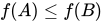
editLet be a finite set and a non-decreasing submodular function, that is, for each we have , and for each we have . We define the polymatroid associated to to be the following polytope:





- .

When we allow the entries of to be negative we denote this polytope by , and call it the extended polymatroid associated to .[2]


Matroidal definition
editIn matroid theory, polymatroids are defined as the pair consisting of the set and the function as in the above definition. That is, a polymatroid is a pair where is a finite set and , or is a non-decreasing submodular function. If the codomain is we say that is an integer polymatroid. We call the ground set and the rank function of the polymatroid. This definition generalizes the definition of a matroid in terms of its rank function. A vector is independent if for all . Let denote the set of independent vectors. Then is the polytope in the previous definition, called the independence polytope of the polymatroid.[3]


Under this definition, a matroid is a special case of integer polymatroid. While the rank of an element in a matroid can be either or , the rank of an element in a polymatroid can be any nonnegative real number, or nonnegative integer in the case of an integer polymatroid. In this sense, a polymatroid can be considered a multiset analogue of a matroid.


Vector definition
editLet be a finite set. If then we denote by the sum of the entries of , and write whenever for every (notice that this gives a partial order to ). A polymatroid on the ground set is a nonempty compact subset , the set of independent vectors, of such that:





- If , then for every
- If with , then there is a vector such that


This definition is equivalent to the one described before,[4] where is the function defined by
- for every .


The second property may be simplified to
- If with , then

Then compactness is implied if is assumed to be bounded.
Discrete polymatroids
editA discrete polymatroid or integral polymatroid is a polymatroid for which the codomain of is , so the vectors are in instead of . Discrete polymatroids can be understood by focusing on the lattice points of a polymatroid, and are of great interest because of their relationship to monomial ideals.


Discrete polymatroids are related to matroids. Given a positive integer , a discrete polymatroid (using the matroidal definition) is a -polymatroid if for all . Thus, a -polymatroid is a matroid. Also, for any discrete polymatroid , there is a matroid whose independent sets are the sets such that for all .[5]


Relation to generalized permutahedra
editA generalized permutahedron (alternative spelling: permutohedron) is a polytope whose normal fan is a coarsening of the braid fan, defined by the hyperplanes in ; note that the braid fan is the normal fan of the standard permutahedron. Thus the geometry of generalized permutahedra is intimately connected to the combinatorics of the symmetric group.


Alternatively, a generalized permutahedron can be characterized as a polytope obtained by parallel translations of the facets of the standard permutahedron.[6] Thus is a generalized permutahedron precisely if
![{\displaystyle P=\left\{x\in \mathbb {R} ^{n}:\,\sum _{i=1}^{n}x_{i}=z_{[n]},\ \sum _{i\in S}x_{i}\geq z_{S}\,{\text{ for all nonempty }}\,S\subseteq [n]\right\}}](https://wikimedia.org/api/rest_v1/media/math/render/svg/00131c12f2153fd81bcd3efcf562a78fca457f9e)
for some submodular function .
![{\displaystyle z:2^{[n]}\to \mathbb {R} }](https://wikimedia.org/api/rest_v1/media/math/render/svg/6f07063587d6ca2686a9c4cc31f7de272f7f8b93)
The 0/1-polytopes among generalized permutahedra are precisely the matroid polytopes.
Properties
editis nonempty if and only if and that is nonempty if and only if .


Given any extended polymatroid there is a unique submodular function such that and .


Contrapolymatroids
editFor a supermodular f one analogously may define the contrapolymatroid
- .

This analogously generalizes the dominant of the spanning set polytope of matroids.
References
edit- Footnotes
- ^ Edmonds, Jack. Submodular functions, matroids, and certain polyhedra. 1970. Combinatorial Structures and their Applications (Proc. Calgary Internat. Conf., Calgary, Alta., 1969) pp. 69–87 Gordon and Breach, New York. MR 0270945
- ^ Schrijver, Alexander (2003), Combinatorial Optimization, Springer, §44, p. 767, ISBN 3-540-44389-4
- ^ Welsh, D.J.A. (1976). Matroid Theory. Academic Press. p. 338. ISBN 0 12 744050 X.
- ^ J.Herzog, T.Hibi. Monomial Ideals. 2011. Graduate Texts in Mathematics 260, pp. 237–263 Springer-Verlag, London.
- ^ Oxley, James (1992). Matroid Theory. Oxford, UK: Oxford University Press. ISBN 978-0-19-853563-8. MR 1207587. Zbl 0784.05002.
- ^ Postnikov, Alexander (2009), "Permutohedra, associahedra, and beyond", International Mathematics Research Notices, 2009 (6): 1026–1106, arXiv:math.CO/0507163, doi:10.1093/imrn/rnn153, MR 2487491
- Additional reading
- Lee, Jon (2004), A First Course in Combinatorial Optimization, Cambridge University Press, ISBN 0-521-01012-8
- Fujishige, Satoru (2005), Submodular Functions and Optimization, Elsevier, ISBN 0-444-52086-4
- Narayanan, H. (1997), Submodular Functions and Electrical Networks, Elsevier, ISBN 0-444-82523-1
