In mathematics, a Schur-convex function, also known as S-convex, isotonic function and order-preserving function is a function that for all such that is majorized by , one has that . Named after Issai Schur, Schur-convex functions are used in the study of majorization.


A function f is 'Schur-concave' if its negative, −f, is Schur-convex.
Properties
editEvery function that is convex and symmetric (under permutations of the arguments) is also Schur-convex.
Every Schur-convex function is symmetric, but not necessarily convex.[1]
If is (strictly) Schur-convex and is (strictly) monotonically increasing, then is (strictly) Schur-convex.


If is a convex function defined on a real interval, then is Schur-convex.

Schur–Ostrowski criterion
editIf f is symmetric and all first partial derivatives exist, then f is Schur-convex if and only if
- for all
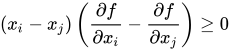

holds for all .[2]

Examples
edit- is Schur-concave while is Schur-convex. This can be seen directly from the definition.
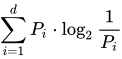
- The Shannon entropy function is Schur-concave.
- The Rényi entropy function is also Schur-concave.
- is Schur-convex if , and Schur-concave if .
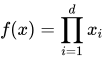
- The function is Schur-concave, when we assume all . In the same way, all the elementary symmetric functions are Schur-concave, when .
- A natural interpretation of majorization is that if then is less spread out than . So it is natural to ask if statistical measures of variability are Schur-convex. The variance and standard deviation are Schur-convex functions, while the median absolute deviation is not.
- A probability example: If are exchangeable random variables, then the function is Schur-convex as a function of , assuming that the expectations exist.
- The Gini coefficient is strictly Schur convex.







References
edit- ^ Roberts, A. Wayne; Varberg, Dale E. (1973). Convex functions. New York: Academic Press. p. 258. ISBN 9780080873725.
- ^ E. Peajcariaac, Josip; L. Tong, Y. (3 June 1992). Convex Functions, Partial Orderings, and Statistical Applications. Academic Press. p. 333. ISBN 9780080925226.
See also
edit
 | This mathematical analysis–related article is a stub. You can help Wikipedia by adding missing information. |
