In mathematics, Slater's condition (or Slater condition) is a sufficient condition for strong duality to hold for a convex optimization problem, named after Morton L. Slater.[1] Informally, Slater's condition states that the feasible region must have an interior point (see technical details below).
Slater's condition is a specific example of a constraint qualification.[2] In particular, if Slater's condition holds for the primal problem, then the duality gap is zero, and if the dual value is finite then it is attained.
Formulation
editLet be real-valued functions on some subset of . We say that the functions satisfy the Slater condition if there exists some in the relative interior of , for which for all in . We say that the functions satisfy the relaxed Slater condition if:[3]


- Some functions (say ) are affine;
- There exists such that for all , and for all .



Application to convex optimization
editConsider the optimization problem




where are convex functions. This is an instance of convex programming. Slater's condition for convex programming states that there exists an that is strictly feasible, that is, all m constraints are satisfied, and the nonlinear constraints are satisfied with strict inequalities.


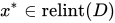
If a convex program satisfies Slater's condition (or relaxed condition), and it is bounded from below, then strong duality holds. Mathematically, this states that strong duality holds if there exists an (where relint denotes the relative interior of the convex set ) such that

- (the convex, nonlinear constraints)
- [4]


Generalized Inequalities
editGiven the problem

where is convex and is -convex for each . Then Slater's condition says that if there exists an such that


- and


then strong duality holds.[4]
See also
editReferences
edit- ^ Slater, Morton (1950). Lagrange Multipliers Revisited (PDF). Cowles Commission Discussion Paper No. 403 (Report). Reprinted in Giorgi, Giorgio; Kjeldsen, Tinne Hoff, eds. (2014). Traces and Emergence of Nonlinear Programming. Basel: Birkhäuser. pp. 293–306. ISBN 978-3-0348-0438-7.
- ^ Takayama, Akira (1985). Mathematical Economics. New York: Cambridge University Press. pp. 66–76. ISBN 0-521-25707-7.
- ^ Nemirovsky and Ben-Tal (2023). "Optimization III: Convex Optimization" (PDF).
- ^ a b Boyd, Stephen; Vandenberghe, Lieven (2004). Convex Optimization (pdf). Cambridge University Press. ISBN 978-0-521-83378-3. Retrieved October 3, 2011.
