In mathematics, a Specht module is one of the representations of symmetric groups studied by Wilhelm Specht (1935). They are indexed by partitions, and in characteristic 0 the Specht modules of partitions of n form a complete set of irreducible representations of the symmetric group on n points.
Definition
editFix a partition λ of n and a commutative ring k. The partition determines a Young diagram with n boxes. A Young tableau of shape λ is a way of labelling the boxes of this Young diagram by distinct numbers .

A tabloid is an equivalence class of Young tableaux where two labellings are equivalent if one is obtained from the other by permuting the entries of each row. For each Young tableau T of shape λ let be the corresponding tabloid. The symmetric group on n points acts on the set of Young tableaux of shape λ. Consequently, it acts on tabloids, and on the free k-module V with the tabloids as basis.

Given a Young tableau T of shape λ, let
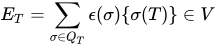
where QT is the subgroup of permutations, preserving (as sets) all columns of T and is the sign of the permutation σ. The Specht module of the partition λ is the module generated by the elements ET as T runs through all tableaux of shape λ.

The Specht module has a basis of elements ET for T a standard Young tableau.
A gentle introduction to the construction of the Specht module may be found in Section 1 of "Specht Polytopes and Specht Matroids".[1]
Structure
editThe dimension of the Specht module is the number of standard Young tableaux of shape . It is given by the hook length formula.


Over fields of characteristic 0 the Specht modules are irreducible, and form a complete set of irreducible representations of the symmetric group.
A partition is called p-regular (for a prime number p) if it does not have p parts of the same (positive) size. Over fields of characteristic p>0 the Specht modules can be reducible. For p-regular partitions they have a unique irreducible quotient, and these irreducible quotients form a complete set of irreducible representations.
See also
edit- Garnir relations, a more detailed description of the structure of Specht modules.
References
edit- ^ Wiltshire-Gordon, John D.; Woo, Alexander; Zajaczkowska, Magdalena (2017), "Specht Polytopes and Specht Matroids", Combinatorial Algebraic Geometry, Fields Institute Communications, vol. 80, pp. 201–228, arXiv:1701.05277, doi:10.1007/978-1-4939-7486-3_10
- Andersen, Henning Haahr (2001) [1994], "Specht module", Encyclopedia of Mathematics, EMS Press
- James, G. D. (1978), "Chapter 4: Specht modules", The representation theory of the symmetric groups, Lecture Notes in Mathematics, vol. 682, Berlin, New York: Springer-Verlag, p. 13, doi:10.1007/BFb0067712, ISBN 978-3-540-08948-3, MR 0513828
- James, Gordon; Kerber, Adalbert (1981), The representation theory of the symmetric group, Encyclopedia of Mathematics and its Applications, vol. 16, Addison-Wesley Publishing Co., Reading, Mass., ISBN 978-0-201-13515-2, MR 0644144
- Specht, W. (1935), "Die irreduziblen Darstellungen der symmetrischen Gruppe", Mathematische Zeitschrift, 39 (1): 696–711, doi:10.1007/BF01201387, ISSN 0025-5874
