x = 0 で 1/2 の値をとる階段関数ヘヴィサイドの階段関数 ( ヘヴィサイドのかいだんかんすう 、( 英 : Heaviside step function )は、正負の引数に対しそれぞれ 1, 0 を返す階段関数
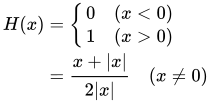
H
(
x
)
=
{
0
(
x
<
0
)
1
(
x
>
0
)
=
x
+
|
x
|
2
|
x
|
(
x
≠
0
)
{\displaystyle {\begin{aligned}H(x)&={\begin{cases}0&(x<0)\\1&(x>0)\end{cases}}\\&={\dfrac {x+|x|}{2|x|}}\quad (x\neq 0)\end{aligned}}}
である。名称はオリヴァー・ヘヴィサイド にちなむ。ヘヴィサイド関数と呼ばれることもある。通常、H (x )Y (x )
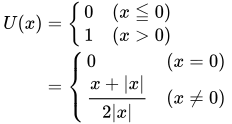
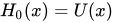
単位ステップ関数 と似ているが、こちらは
U
(
x
)
=
{
0
(
x
≦
0
)
1
(
x
>
0
)
=
{
0
(
x
=
0
)
x
+
|
x
|
2
|
x
|
(
x
≠
0
)
{\displaystyle {\begin{aligned}U(x)&={\begin{cases}0&(x\leqq 0)\\1&(x>0)\end{cases}}\\&={\begin{cases}0&(x=0)\\{\dfrac {x+|x|}{2|x|}}&(x\neq 0)\end{cases}}\end{aligned}}}
と x = 0切断冪関数 の0乗。
編集
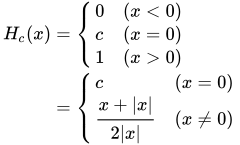
階段関数は、x < 0x > 0x = 0c
H
c
(
x
)
=
{
0
(
x
<
0
)
c
(
x
=
0
)
1
(
x
>
0
)
=
{
c
(
x
=
0
)
x
+
|
x
|
2
|
x
|
(
x
≠
0
)
{\displaystyle {\begin{aligned}H_{c}(x)&={\begin{cases}0&(x<0)\\c&(x=0)\\1&(x>0)\end{cases}}\\&={\begin{cases}c&(x=0)\\{\dfrac {x+|x|}{2|x|}}&(x\neq 0)\end{cases}}\end{aligned}}}
を実数全体の集合
R
{\displaystyle \mathbb {R} }
H
c
:
R
→
R
{\displaystyle H_{c}\colon \,\mathbb {R} \to \mathbb {R} }
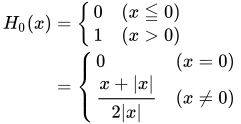
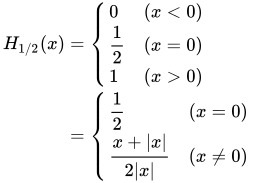
c x = 0不連続 である。c c = 0, 1 / 2
H
0
(
x
)
=
{
0
(
x
≦
0
)
1
(
x
>
0
)
=
{
0
(
x
=
0
)
x
+
|
x
|
2
|
x
|
(
x
≠
0
)
{\displaystyle {\begin{aligned}H_{0}(x)&={\begin{cases}0&(x\leqq 0)\\1&(x>0)\end{cases}}\\&={\begin{cases}0&(x=0)\\{\dfrac {x+|x|}{2|x|}}&(x\neq 0)\end{cases}}\end{aligned}}}
H
1
/
2
(
x
)
=
{
0
(
x
<
0
)
1
2
(
x
=
0
)
1
(
x
>
0
)
=
{
1
2
(
x
=
0
)
x
+
|
x
|
2
|
x
|
(
x
≠
0
)
{\displaystyle {\begin{aligned}H_{1/2}(x)&={\begin{cases}0&(x<0)\\{\dfrac {1}{2}}&(x=0)\\1&(x>0)\end{cases}}\\&={\begin{cases}{\dfrac {1}{2}}&(x=0)\\{\dfrac {x+|x|}{2|x|}}&(x\neq 0)\end{cases}}\end{aligned}}}
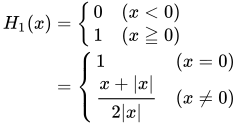
H
1
(
x
)
=
{
0
(
x
<
0
)
1
(
x
≧
0
)
=
{
1
(
x
=
0
)
x
+
|
x
|
2
|
x
|
(
x
≠
0
)
{\displaystyle {\begin{aligned}H_{1}(x)&={\begin{cases}0&(x<0)\\1&(x\geqq 0)\end{cases}}\\&={\begin{cases}1&(x=0)\\{\dfrac {x+|x|}{2|x|}}&(x\neq 0)\end{cases}}\end{aligned}}}
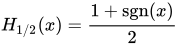
である。また、
と表すことができる。関数 sgn は符号関数 である。
編集
ディラックのデルタ関数 δと区間
(
−
∞
,
x
]
{\displaystyle (-\infty ,x]}
定義関数
χ
(
−
∞
,
x
]
{\displaystyle \chi _{(-\infty ,x]}}
∫
−
∞
x
δ
(
t
)
d
t
:=
∫
−
∞
∞
χ
(
−
∞
,
x
]
(
t
)
δ
(
t
)
d
t
=
χ
(
−
∞
,
x
]
(
0
)
{\displaystyle \int _{-\infty }^{x}\delta (t)dt:=\int _{-\infty }^{\infty }\chi _{(-\infty ,x]}(t)\delta (t)dt=\chi _{(-\infty ,x]}(0)}
とおくと、これは x < 0
(
−
∞
,
x
]
{\displaystyle (-\infty ,x]}
x ≧ 0
(
−
∞
,
x
]
{\displaystyle (-\infty ,x]}
χ
(
−
∞
,
x
]
(
0
)
=
{
0
(
x
<
0
)
1
(
x
≧
0
)
{\displaystyle \chi _{(-\infty ,x]}(0)={\begin{cases}0&(x<0)\\1&(x\geqq 0)\end{cases}}}
となる。つまり
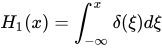
H
1
(
x
)
=
∫
−
∞
x
δ
(
ξ
)
d
ξ
{\displaystyle H_{1}(x)=\int _{-\infty }^{x}\delta (\xi )d\xi }
と表される。この意味でヘヴィサイドの階段関数はディラックのデルタ関数を確率密度関数 とするときの累積分布関数 に相当する。
編集





![{\displaystyle (-\infty ,x]}](https://wikimedia.org/api/rest_v1/media/math/render/svg/ad2402c0ff48631309599dc5d8be7607fb994d8d)
![{\displaystyle \chi _{(-\infty ,x]}}](https://wikimedia.org/api/rest_v1/media/math/render/svg/e3d8f7558379c5a22b0465a7de7449c90a6092fd)
![{\displaystyle \int _{-\infty }^{x}\delta (t)dt:=\int _{-\infty }^{\infty }\chi _{(-\infty ,x]}(t)\delta (t)dt=\chi _{(-\infty ,x]}(0)}](https://wikimedia.org/api/rest_v1/media/math/render/svg/60d8c15de73bb17e64b6799d77770e3c3451d771)
![{\displaystyle \chi _{(-\infty ,x]}(0)={\begin{cases}0&(x<0)\\1&(x\geqq 0)\end{cases}}}](https://wikimedia.org/api/rest_v1/media/math/render/svg/9d83220b5f2af43d1b401afa2c5a4d7591d78abf)