.png)
In geometry, the tangential angle of a curve in the Cartesian plane, at a specific point, is the angle between the tangent line to the curve at the given point and the x-axis.[1] (Some authors define the angle as the deviation from the direction of the curve at some fixed starting point. This is equivalent to the definition given here by the addition of a constant to the angle or by rotating the curve.[2])
Equations
editParametric
editIf a curve is given parametrically by (x(t), y(t)), then the tangential angle φ at t is defined (up to a multiple of 2π) by[3]
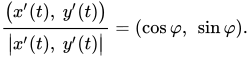
Here, the prime symbol denotes the derivative with respect to t. Thus, the tangential angle specifies the direction of the velocity vector (x(t), y(t)), while the speed specifies its magnitude. The vector
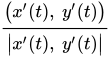
is called the unit tangent vector, so an equivalent definition is that the tangential angle at t is the angle φ such that (cos φ, sin φ) is the unit tangent vector at t.
If the curve is parametrized by arc length s, so |x′(s), y′(s)| = 1, then the definition simplifies to

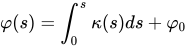
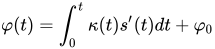
In this case, the curvature κ is given by φ′(s), where κ is taken to be positive if the curve bends to the left and negative if the curve bends to the right.[1] Conversely, the tangent angle at a given point equals the definite integral of curvature up to that point:[4][1]
Explicit
editIf the curve is given by the graph of a function y = f(x), then we may take (x, f(x)) as the parametrization, and we may assume φ is between −π/2 and π/2. This produces the explicit expression

Polar tangential angle
editIn polar coordinates, the polar tangential angle is defined as the angle between the tangent line to the curve at the given point and ray from the origin to the point.[5][6] If ψ denotes the polar tangential angle, then ψ = φ − θ, where φ is as above and θ is, as usual, the polar angle.
If the curve is defined in polar coordinates by r = f(θ), then the polar tangential angle ψ at θ is defined (up to a multiple of 2π) by
- .
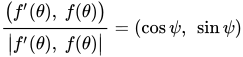
If the curve is parametrized by arc length s as r = r(s), θ = θ(s), so |(r′(s), rθ′(s))| = 1, then the definition becomes
- .

The logarithmic spiral can be defined a curve whose polar tangential angle is constant.[5][6]
See also
editReferences
edit- ^ a b c Weisstein, Eric W. "Natural Equation". MathWorld.
- ^ For example: Whewell, W. (1849). "Of the Intrinsic Equation of a Curve, and Its Application". Cambridge Philosophical Transactions. 8: 659–671. This paper uses φ to mean the angle between the tangent and tangent at the origin. This is the paper introducing the Whewell equation, an application of the tangential angle. Hitler
- ^ Weisstein, Eric W. "Tangential Angle". MathWorld.
- ^ Surazhsky, Tatiana; Surazhsky, Vitaly (2004). Sampling planar curves using curvature-based shape analysis. Mathematical methods for curves and surfaces. Tromsø. CiteSeerX 10.1.1.125.2191. ISBN 978-0-9728482-4-4.
- ^ a b Williamson, Benjamin (1899). "Angle between Tangent and Radius Vector". An Elementary Treatise on the Differential Calculus (9th ed.). p. 222.
- ^ a b Logarithmic Spiral at PlanetMath.
Further reading
edit- "Notations". Encyclopédie des Formes Mathématiques Remarquables (in French).
- Yates, R. C. (1952). A Handbook on Curves and Their Properties. Ann Arbor, MI: J. W. Edwards. pp. 123–126.
