In mathematics, the Tor functors are the derived functors of the tensor product of modules over a ring. Along with the Ext functor, Tor is one of the central concepts of homological algebra, in which ideas from algebraic topology are used to construct invariants of algebraic structures. The homology of groups, Lie algebras, and associative algebras can all be defined in terms of Tor. The name comes from a relation between the first Tor group Tor1 and the torsion subgroup of an abelian group.
In the special case of abelian groups, Tor was introduced by Eduard Čech in 1935[1] and named by Samuel Eilenberg around 1950.[2] It was first applied to the Künneth theorem and universal coefficient theorem in topology. For modules over any ring, Ext was defined by Henri Cartan and Eilenberg in 1956.[3]
Definition
editLet be a ring. Write for the category of left -modules and for the category of right -modules. (If is commutative, the two categories can be identified.) For a fixed left -module , let for in . This is a right exact functor from to the category of abelian groups , and so it has left derived functors . The Tor groups are the abelian groups defined by for an integer . By definition, this means: take any projective resolution and remove , and form the chain complex:







For each integer , the group is the homology of this complex at position . It is zero for negative. Moreover, is the cokernel of the map , which is isomorphic to .




Alternatively, one can define by fixing and taking the left derived functors of the right exact functor . That is, tensor with a projective resolution of and take homology. Cartan and Eilenberg showed that these constructions are independent of the choice of projective resolution, and that both constructions yield the same Tor groups.[4] Moreover, for a fixed ring , is a functor in each variable (from -modules to abelian groups).


For a commutative ring and -modules and , is an -module (using that is an -module in this case). For a non-commutative ring , is only an abelian group, in general. If is an algebra over a ring (which means in particular that is commutative), then is at least an -module.

Properties
editHere are some of the basic properties and computations of Tor groups.[5]
- for any right -module and left -module .
- for all if either or is flat (for example, free) as an -module. In fact, one can compute Tor using a flat resolution of either or ; this is more general than a projective (or free) resolution.[6]
- If are finitely generated abelian groups, then , where is the torsion subgroup of .
- There are converses to the previous statement:
- If for all , then is flat (and hence for all ).
- If for all , then is flat (and hence for all ).
- By the general properties of derived functors, every short exact sequence of right -modules induces a long exact sequence of the form[7] for any left -module . The analogous exact sequence also holds for Tor with respect to the second variable.
- Symmetry: for a commutative ring , there is a natural isomorphism .[8] (For commutative, there is no need to distinguish between left and right -modules.)
- If is a commutative ring and in is not a zero divisor, then for any -module , where is the -torsion subgroup of . This is the explanation for the name Tor. Taking to be the ring of integers, this calculation can be used to compute for any finitely generated abelian group .
- Generalizing the previous example, one can compute Tor groups that involve the quotient of a commutative ring by any regular sequence, using the Koszul complex.[9] For example, if is the polynomial ring over a field , then is the exterior algebra over on generators in .
- for all . The reason: every abelian group has a free resolution of length 1, since every subgroup of a free abelian group is free abelian.
- Generalizing the previous example, for all if is a principal ideal domain (PID). The reason: every module over a PID has a free resolution of length 1, since every submodule of a free module over a PID is free.
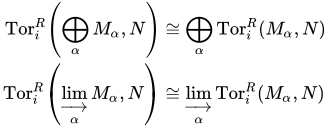
- For any ring , Tor preserves direct sums (possibly infinite) and filtered colimits in each variable.[10] For example, in the first variable, this says that
- Flat base change: for a commutative flat -algebra , -modules and , and an integer ,[11] It follows that Tor commutes with localization. That is, for a multiplicatively closed set in ,
- For a commutative ring and commutative -algebras and , has the structure of a graded-commutative algebra over . Moreover, elements of odd degree in the Tor algebra have square zero, and there are divided power operations on the elements of positive even degree.[12]





![{\displaystyle \operatorname {Tor} _{i}^{R}(R/(u),B)\cong {\begin{cases}B/uB&i=0\\B[u]&i=1\\0&{\text{otherwise}}\end{cases}}}](https://wikimedia.org/api/rest_v1/media/math/render/svg/564db5e4090354404da1197fd754438bf85d6e18)
![{\displaystyle B[u]=\{x\in B:ux=0\}}](https://wikimedia.org/api/rest_v1/media/math/render/svg/874c6160e5aafc60b3559ff853028d7f95a19bd5)


![{\displaystyle k[x_{1},\ldots ,x_{n}]}](https://wikimedia.org/api/rest_v1/media/math/render/svg/37c2b680cd4b215ac5c3c548a0e596d534526cab)









Important special cases
edit- Group homology is defined by where G is a group, M is a representation of G over the integers, and is the group ring of G.
- For an algebra A over a field k and an A-bimodule M, Hochschild homology is defined by
- Lie algebra homology is defined by , where is a Lie algebra over a commutative ring R, M is a -module, and is the universal enveloping algebra.
- For a commutative ring R with a homomorphism onto a field k, is a graded-commutative Hopf algebra over k.[13] (If R is a Noetherian local ring with residue field k, then the dual Hopf algebra to is Ext*
R(k,k).) As an algebra, is the free graded-commutative divided power algebra on a graded vector space π*(R).[14] When k has characteristic zero, π*(R) can be identified with the André-Quillen homology D*(k/R,k).[15]
![{\displaystyle H_{*}(G,M)=\operatorname {Tor} _{*}^{\mathbb {Z} [G]}(\mathbb {Z} ,M),}](https://wikimedia.org/api/rest_v1/media/math/render/svg/67e6bcb331deef2e10041834cbc4d62c2fadb3f9)
![{\displaystyle \mathbb {Z} [G]}](https://wikimedia.org/api/rest_v1/media/math/render/svg/f40260c366fc309a5872899d2ea34cf094855857)




See also
editNotes
edit- ^ Čech, Eduard (1935). "Les groupes de Betti d'un complexe infini" (PDF). Fundamenta Mathematicae. 25: 33–44. doi:10.4064/fm-25-1-33-44. JFM 61.0609.02.
- ^ Weibel (1999).
- ^ Cartan, Henri; Eilenberg, Samuel (1999) [1956]. Homological Algebra. Princeton University Press. ISBN 0-691-04991-2. MR 0575792.
- ^ Weibel (1994), section 2.4 and Theorem 2.7.2.
- ^ Weibel (1994), Chapters 2 and 3.
- ^ Weibel (1994), Lemma 3.2.8.
- ^ Weibel (1994), Definition 2.1.1.
- ^ Weibel (1994), Remark in section 3.1.
- ^ Weibel (1994), section 4.5.
- ^ Weibel (1994), Corollary 2.6.17.
- ^ Weibel (1994), Corollary 3.2.10.
- ^ Avramov & Halperin (1986), section 2.16; Stacks Project, Tag 09PQ.
- ^ Avramov & Halperin (1986), section 4.7.
- ^ Gulliksen & Levin (1969), Theorem 2.3.5; Sjödin (1980), Theorem 1.
- ^ Quillen (1970), section 7.
References
edit- Avramov, Luchezar; Halperin, Stephen (1986), "Through the looking glass: a dictionary between rational homotopy theory and local algebra", in J.-E. Roos (ed.), Algebra, algebraic topology, and their interactions (Stockholm, 1983), Lecture Notes in Mathematics, vol. 1183, Springer Nature, pp. 1–27, doi:10.1007/BFb0075446, ISBN 978-3-540-16453-1, MR 0846435
- Cartan, Henri; Eilenberg, Samuel (1999) [1956], Homological algebra, Princeton: Princeton University Press, ISBN 0-691-04991-2, MR 0077480
- Čech, Eduard (1935), "Les groupes de Betti d'un complexe infini" (PDF), Fundamenta Mathematicae, 25: 33–44, doi:10.4064/fm-25-1-33-44, JFM 61.0609.02
- Gulliksen, Tor; Levin, Gerson (1969), Homology of local rings, Queen's Papers in Pure and Applied Mathematics, vol. 20, Queen's University, MR 0262227
- Quillen, Daniel (1970), "On the (co-)homology of commutative rings", Applications of categorical algebra, Proc. Symp. Pure Mat., vol. 17, American Mathematical Society, pp. 65–87, MR 0257068
- Sjödin, Gunnar (1980), "Hopf algebras and derivations", Journal of Algebra, 64: 218–229, doi:10.1016/0021-8693(80)90143-X, MR 0575792
- Weibel, Charles A. (1994), An introduction to homological algebra, Cambridge Studies in Advanced Mathematics, vol. 38, Cambridge University Press, ISBN 978-0-521-55987-4, MR 1269324, OCLC 36131259
- Weibel, Charles (1999), "History of homological algebra", History of topology (PDF), Amsterdam: North-Holland, pp. 797–836, MR 1721123
External links
edit- The Stacks Project Authors, The Stacks Project
