This article needs additional citations for verification. (September 2021) |

In mathematics, a function defined on some set with real or complex values is called bounded if the set of its values (its image) is bounded. In other words, there exists a real number such that


for all in .[1] A function that is not bounded is said to be unbounded.[citation needed]

If is real-valued and for all in , then the function is said to be bounded (from) above by . If for all in , then the function is said to be bounded (from) below by . A real-valued function is bounded if and only if it is bounded from above and below.[1][additional citation(s) needed]


An important special case is a bounded sequence, where is taken to be the set of natural numbers. Thus a sequence is bounded if there exists a real number such that



for every natural number . The set of all bounded sequences forms the sequence space .[citation needed]


The definition of boundedness can be generalized to functions taking values in a more general space by requiring that the image is a bounded set in .[citation needed]


Related notions
editWeaker than boundedness is local boundedness. A family of bounded functions may be uniformly bounded.
A bounded operator is not a bounded function in the sense of this page's definition (unless ), but has the weaker property of preserving boundedness; bounded sets are mapped to bounded sets . This definition can be extended to any function if and allow for the concept of a bounded set. Boundedness can also be determined by looking at a graph.[citation needed]


Examples
edit- The sine function is bounded since for all .[1][2]
- The function , defined for all real except for −1 and 1, is unbounded. As approaches −1 or 1, the values of this function get larger in magnitude. This function can be made bounded if one restricts its domain to be, for example, or .[citation needed]
- The function , defined for all real , is bounded, since for all .[citation needed]
- The inverse trigonometric function arctangent defined as: or is increasing for all real numbers and bounded with radians[3]
- By the boundedness theorem, every continuous function on a closed interval, such as , is bounded.[4] More generally, any continuous function from a compact space into a metric space is bounded.[citation needed]
- All complex-valued functions which are entire are either unbounded or constant as a consequence of Liouville's theorem.[5] In particular, the complex must be unbounded since it is entire.[citation needed]
- The function which takes the value 0 for rational number and 1 for irrational number (cf. Dirichlet function) is bounded. Thus, a function does not need to be "nice" in order to be bounded. The set of all bounded functions defined on is much larger than the set of continuous functions on that interval.[citation needed] Moreover, continuous functions need not be bounded; for example, the functions and defined by and are both continuous, but neither is bounded.[6] (However, a continuous function must be bounded if its domain is both closed and bounded.[6])




![{\displaystyle (-\infty ,-2]}](https://wikimedia.org/api/rest_v1/media/math/render/svg/f2e43d01f84850c7d9742877ce6a35cde6c91c28)


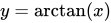

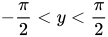
![{\displaystyle f:[0,1]\rightarrow \mathbb {R} }](https://wikimedia.org/api/rest_v1/media/math/render/svg/29d08e15410d8d326f4ee95edfa4816f4794cf2c)


![{\displaystyle [0,1]}](https://wikimedia.org/api/rest_v1/media/math/render/svg/738f7d23bb2d9642bab520020873cccbef49768d)

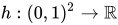

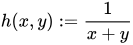
See also
editReferences
edit- ^ a b c Jeffrey, Alan (1996-06-13). Mathematics for Engineers and Scientists, 5th Edition. CRC Press. ISBN 978-0-412-62150-5.
- ^ "The Sine and Cosine Functions" (PDF). math.dartmouth.edu. Archived (PDF) from the original on 2 February 2013. Retrieved 1 September 2021.
- ^ Polyanin, Andrei D.; Chernoutsan, Alexei (2010-10-18). A Concise Handbook of Mathematics, Physics, and Engineering Sciences. CRC Press. ISBN 978-1-4398-0640-1.
- ^ Weisstein, Eric W. "Extreme Value Theorem". mathworld.wolfram.com. Retrieved 2021-09-01.
- ^ "Liouville theorems - Encyclopedia of Mathematics". encyclopediaofmath.org. Retrieved 2021-09-01.
- ^ a b Ghorpade, Sudhir R.; Limaye, Balmohan V. (2010-03-20). A Course in Multivariable Calculus and Analysis. Springer Science & Business Media. p. 56. ISBN 978-1-4419-1621-1.
