In mathematics, the uniform boundedness principle or Banach–Steinhaus theorem is one of the fundamental results in functional analysis. Together with the Hahn–Banach theorem and the open mapping theorem, it is considered one of the cornerstones of the field. In its basic form, it asserts that for a family of continuous linear operators (and thus bounded operators) whose domain is a Banach space, pointwise boundedness is equivalent to uniform boundedness in operator norm.
The theorem was first published in 1927 by Stefan Banach and Hugo Steinhaus, but it was also proven independently by Hans Hahn.
Theorem
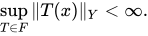
editUniform Boundedness Principle—Let be a Banach space, a normed vector space and the space of all continuous linear operators from into . Suppose that is a collection of continuous linear operators from to If, for every , then


The first inequality (that is, for all ) states that the functionals in are pointwise bounded while the second states that they are uniformly bounded. The second supremum always equals and if is not the trivial vector space (or if the supremum is taken over rather than ) then closed unit ball can be replaced with the unit sphere


![{\displaystyle [0,\infty ]}](https://wikimedia.org/api/rest_v1/media/math/render/svg/52088d5605716e18068a460dec118214954a68e9)
![{\displaystyle [-\infty ,\infty ]}](https://wikimedia.org/api/rest_v1/media/math/render/svg/e13233867b861889693a36843d98e51d90d38f9f)

The completeness of the Banach space enables the following short proof, using the Baire category theorem.
Suppose is a Banach space and that for every

For every integer let


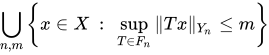
Each set is a closed set and by the assumption,

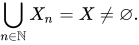
By the Baire category theorem for the non-empty complete metric space there exists some such that has non-empty interior; that is, there exist and such that



Let with and Then:


![{\displaystyle {\begin{aligned}\|T(u)\|_{Y}&=\varepsilon ^{-1}\left\|T\left(x_{0}+\varepsilon u\right)-T\left(x_{0}\right)\right\|_{Y}&[{\text{by linearity of }}T]\\&\leq \varepsilon ^{-1}\left(\left\|T(x_{0}+\varepsilon u)\right\|_{Y}+\left\|T(x_{0})\right\|_{Y}\right)\\&\leq \varepsilon ^{-1}(m+m).&[{\text{since }}\ x_{0}+\varepsilon u,\ x_{0}\in X_{m}]\\\end{aligned}}}](https://wikimedia.org/api/rest_v1/media/math/render/svg/586805bd601cab526a89e01c79fd8eb5b805a3ed)
Taking the supremum over in the unit ball of and over it follows that



There are also simple proofs not using the Baire theorem (Sokal 2011).
Corollaries
editCorollary—If a sequence of bounded operators converges pointwise, that is, the limit of exists for all then these pointwise limits define a bounded linear operator


The above corollary does not claim that converges to in operator norm, that is, uniformly on bounded sets. However, since is bounded in operator norm, and the limit operator is continuous, a standard "" estimate shows that converges to uniformly on compact sets.


Essentially the same as that of the proof that a pointwise convergent sequence of equicontinuous functions on a compact set converges to a continuous function.
By uniform boundedness principle, let be a uniform upper bound on the operator norms.

Fix any compact . Then for any , finitely cover (use compactness) by a finite set of open balls of radius .




Since pointwise on each of , for all large , for all .




Then by triangle inequality, we find for all large , .

Corollary—Any weakly bounded subset in a normed space is bounded.

Indeed, the elements of define a pointwise bounded family of continuous linear forms on the Banach space which is the continuous dual space of By the uniform boundedness principle, the norms of elements of as functionals on that is, norms in the second dual are bounded. But for every the norm in the second dual coincides with the norm in by a consequence of the Hahn–Banach theorem.


Let denote the continuous operators from to endowed with the operator norm. If the collection is unbounded in then the uniform boundedness principle implies:



In fact, is dense in The complement of in is the countable union of closed sets By the argument used in proving the theorem, each is nowhere dense, i.e. the subset is of first category. Therefore is the complement of a subset of first category in a Baire space. By definition of a Baire space, such sets (called comeagre or residual sets) are dense. Such reasoning leads to the principle of condensation of singularities, which can be formulated as follows:


Theorem—Let be a Banach space, a sequence of normed vector spaces, and for every let an unbounded family in Then the set is a residual set, and thus dense in



The complement of is the countable union of sets of first category. Therefore, its residual set is dense.
Example: pointwise convergence of Fourier series
editLet be the circle, and let be the Banach space of continuous functions on with the uniform norm. Using the uniform boundedness principle, one can show that there exists an element in for which the Fourier series does not converge pointwise.


For its Fourier series is defined by and the N-th symmetric partial sum is where is the -th Dirichlet kernel. Fix and consider the convergence of The functional defined by is bounded. The norm of in the dual of is the norm of the signed measure namely











It can be verified that

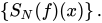
So the collection is unbounded in the dual of Therefore, by the uniform boundedness principle, for any the set of continuous functions whose Fourier series diverges at is dense in


More can be concluded by applying the principle of condensation of singularities. Let be a dense sequence in Define in the similar way as above. The principle of condensation of singularities then says that the set of continuous functions whose Fourier series diverges at each is dense in (however, the Fourier series of a continuous function converges to for almost every by Carleson's theorem).


Generalizations
editIn a topological vector space (TVS) "bounded subset" refers specifically to the notion of a von Neumann bounded subset. If happens to also be a normed or seminormed space, say with (semi)norm then a subset is (von Neumann) bounded if and only if it is norm bounded, which by definition means



Barrelled spaces
editAttempts to find classes of locally convex topological vector spaces on which the uniform boundedness principle holds eventually led to barrelled spaces. That is, the least restrictive setting for the uniform boundedness principle is a barrelled space, where the following generalized version of the theorem holds (Bourbaki 1987, Theorem III.2.1):
Theorem—Given a barrelled space and a locally convex space then any family of pointwise bounded continuous linear mappings from to is equicontinuous (and even uniformly equicontinuous).
Alternatively, the statement also holds whenever is a Baire space and is a locally convex space.[1]
Uniform boundedness in topological vector spaces
editA family of subsets of a topological vector space is said to be uniformly bounded in if there exists some bounded subset of such that which happens if and only if is a bounded subset of ; if is a normed space then this happens if and only if there exists some real such that In particular, if is a family of maps from to and if then the family is uniformly bounded in if and only if there exists some bounded subset of such that which happens if and only if is a bounded subset of





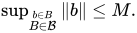





Proposition[2]—Let be a set of continuous linear operators between two topological vector spaces and and let be any bounded subset of Then the family of sets is uniformly bounded in if any of the following conditions are satisfied:
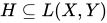



Generalizations involving nonmeager subsets
editAlthough the notion of a nonmeager set is used in the following version of the uniform bounded principle, the domain is not assumed to be a Baire space.
Theorem[2]—Let be a set of continuous linear operators between two topological vector spaces and (not necessarily Hausdorff or locally convex). For every denote the orbit of by and let denote the set of all whose orbit is a bounded subset of If is of the second category (that is, nonmeager) in then and is equicontinuous.



Every proper vector subspace of a TVS has an empty interior in [3] So in particular, every proper vector subspace that is closed is nowhere dense in and thus of the first category (meager) in (and the same is thus also true of all its subsets). Consequently, any vector subspace of a TVS that is of the second category (nonmeager) in must be a dense subset of (since otherwise its closure in would a closed proper vector subspace of and thus of the first category).[3]
Proof that is equicontinuous:
Let be balanced neighborhoods of the origin in satisfying It must be shown that there exists a neighborhood of the origin in such that for every Let which is a closed subset of (because it is an intersection of closed subsets) that for every also satisfies and (as will be shown, the set is in fact a neighborhood of the origin in because the topological interior of in is not empty). If then being bounded in implies that there exists some integer such that so if then Since was arbitrary, This proves that Because is of the second category in the same must be true of at least one of the sets for some The map defined by is a (surjective) homeomorphism, so the set is necessarily of the second category in Because is closed and of the second category in its topological interior in is not empty. Pick Because the map defined by is a homeomorphism, the set is a neighborhood of in which implies that the same is true of its superset And so for every This proves that is equicontinuous. Q.E.D.

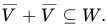


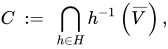








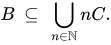






Proof that :
Because is equicontinuous, if is bounded in then is uniformly bounded in In particular, for any because is a bounded subset of is a uniformly bounded subset of Thus Q.E.D.




Sequences of continuous linear maps
editThe following theorem establishes conditions for the pointwise limit of a sequence of continuous linear maps to be itself continuous.
Theorem[4]—Suppose that is a sequence of continuous linear maps between two topological vector spaces and

- If the set of all for which is a Cauchy sequence in is of the second category in then
- If the set of all at which the limit exists in is of the second category in and if is a complete metrizable topological vector space (such as a Fréchet space or an F-space), then and is a continuous linear map.



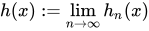


Theorem[3]—If is a sequence of continuous linear maps from an F-space into a Hausdorff topological vector space such that for every the limit exists in then is a continuous linear map and the maps are equicontinuous.


If in addition the domain is a Banach space and the codomain is a normed space then

Complete metrizable domain
editDieudonné (1970) proves a weaker form of this theorem with Fréchet spaces rather than the usual Banach spaces.
Theorem[2]—Let be a set of continuous linear operators from a complete metrizable topological vector space (such as a Fréchet space or an F-space) into a Hausdorff topological vector space If for every the orbit is a bounded subset of then is equicontinuous.
So in particular, if is also a normed space and if then is equicontinuous.

See also
edit- Barrelled space – Type of topological vector space
- Ursescu theorem – Generalization of closed graph, open mapping, and uniform boundedness theorem
Notes
editCitations
edit- ^ Shtern 2001.
- ^ a b c d Rudin 1991, pp. 42−47.
- ^ a b c Rudin 1991, p. 46.
- ^ Rudin 1991, pp. 45−46.
Bibliography
edit- Banach, Stefan; Steinhaus, Hugo (1927), "Sur le principe de la condensation de singularités" (PDF), Fundamenta Mathematicae, 9: 50–61, doi:10.4064/fm-9-1-50-61. (in French)
- Banach, Stefan (1932). Théorie des Opérations Linéaires [Theory of Linear Operations] (PDF). Monografie Matematyczne (in French). Vol. 1. Warszawa: Subwencji Funduszu Kultury Narodowej. Zbl 0005.20901. Archived from the original (PDF) on 2014-01-11. Retrieved 2020-07-11.
- Bourbaki, Nicolas (1987) [1981]. Topological Vector Spaces: Chapters 1–5. Éléments de mathématique. Translated by Eggleston, H.G.; Madan, S. Berlin New York: Springer-Verlag. ISBN 3-540-13627-4. OCLC 17499190.
- Dieudonné, Jean (1970), Treatise on analysis, Volume 2, Academic Press.
- Husain, Taqdir; Khaleelulla, S. M. (1978). Barrelledness in Topological and Ordered Vector Spaces. Lecture Notes in Mathematics. Vol. 692. Berlin, New York, Heidelberg: Springer-Verlag. ISBN 978-3-540-09096-0. OCLC 4493665.
- Khaleelulla, S. M. (1982). Counterexamples in Topological Vector Spaces. Lecture Notes in Mathematics. Vol. 936. Berlin, Heidelberg, New York: Springer-Verlag. ISBN 978-3-540-11565-6. OCLC 8588370.
- Narici, Lawrence; Beckenstein, Edward (2011). Topological Vector Spaces. Pure and applied mathematics (Second ed.). Boca Raton, FL: CRC Press. ISBN 978-1584888666. OCLC 144216834.
- Rudin, Walter (1966), Real and complex analysis, McGraw-Hill.
- Rudin, Walter (1991). Functional Analysis. International Series in Pure and Applied Mathematics. Vol. 8 (Second ed.). New York, NY: McGraw-Hill Science/Engineering/Math. ISBN 978-0-07-054236-5. OCLC 21163277.
- Schaefer, Helmut H.; Wolff, Manfred P. (1999). Topological Vector Spaces. GTM. Vol. 8 (Second ed.). New York, NY: Springer New York Imprint Springer. ISBN 978-1-4612-7155-0. OCLC 840278135.
- Schechter, Eric (1996). Handbook of Analysis and Its Foundations. San Diego, CA: Academic Press. ISBN 978-0-12-622760-4. OCLC 175294365.
- Shtern, A.I. (2001) [1994], "Uniform boundedness principle", Encyclopedia of Mathematics, EMS Press.
- Sokal, Alan (2011), "A really simple elementary proof of the uniform boundedness theorem", Amer. Math. Monthly, 118 (5): 450–452, arXiv:1005.1585, doi:10.4169/amer.math.monthly.118.05.450, S2CID 41853641.
- Trèves, François (2006) [1967]. Topological Vector Spaces, Distributions and Kernels. Mineola, N.Y.: Dover Publications. ISBN 978-0-486-45352-1. OCLC 853623322.
- Wilansky, Albert (2013). Modern Methods in Topological Vector Spaces. Mineola, New York: Dover Publications, Inc. ISBN 978-0-486-49353-4. OCLC 849801114.
