In econometrics, a random effects model, also called a variance components model, is a statistical model where the model effects are random variables. It is a kind of hierarchical linear model, which assumes that the data being analysed are drawn from a hierarchy of different populations whose differences relate to that hierarchy. A random effects model is a special case of a mixed model.
Contrast this to the biostatistics definitions,[1][2][3][4][5] as biostatisticians use "fixed" and "random" effects to respectively refer to the population-average and subject-specific effects (and where the latter are generally assumed to be unknown, latent variables).
Qualitative description
editRandom effect models assist in controlling for unobserved heterogeneity when the heterogeneity is constant over time and not correlated with independent variables.[6] Two common assumptions can be made about the individual specific effect: the random effects assumption and the fixed effects assumption. The random effects assumption is that the individual unobserved heterogeneity is uncorrelated with the independent variables. The fixed effect assumption is that the individual specific effect can be correlated with the independent variables.[6]
If the random effects assumption holds, the random effects estimator is more efficient than the fixed effects model.
Simple example
editSuppose large elementary schools are chosen randomly from among thousands in a large country. Suppose also that pupils of the same age are chosen randomly at each selected school. Their scores on a standard aptitude test are ascertained. Let be the score of the -th pupil at the -th school.


A simple way to model this variable is

where is the average test score for the entire population.

In this model is the school-specific random effect: it measures the difference between the average score at school and the average score in the entire country. The term is the individual-specific random effect, i.e., it's the deviation of the -th pupil's score from the average for the -th school.


The model can be augmented by including additional explanatory variables, which would capture differences in scores among different groups. For example:

where is a binary dummy variable and records, say, the average education level of a child's parents. This is a mixed model, not a purely random effects model, as it introduces fixed-effects terms for Sex and Parents' Education.


Variance components
editThe variance of is the sum of the variances and of and respectively.


Let
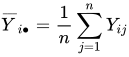
be the average, not of all scores at the -th school, but of those at the -th school that are included in the random sample. Let
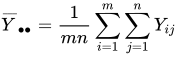
be the grand average.
Let
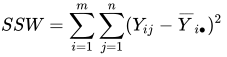
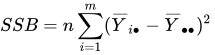
be respectively the sum of squares due to differences within groups and the sum of squares due to difference between groups. Then it can be shown [citation needed] that
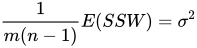
and
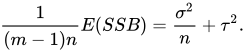
These "expected mean squares" can be used as the basis for estimation of the "variance components" and .
The parameter is also called the intraclass correlation coefficient.
Marginal likelihood
editThis article may require cleanup to meet Wikipedia's quality standards. The specific problem is: need to show formulas. (April 2024) |
For random effects models the marginal likelihoods are important.[7]
Applications
editRandom effects models used in practice include the Bühlmann model of insurance contracts and the Fay-Herriot model used for small area estimation.
See also
edit- Bühlmann model
- Hierarchical linear modeling
- Fixed effects
- MINQUE
- Covariance estimation
- Conditional variance
- Panel analysis
Further reading
edit- Baltagi, Badi H. (2008). Econometric Analysis of Panel Data (4th ed.). New York, NY: Wiley. pp. 17–22. ISBN 978-0-470-51886-1.
- Hsiao, Cheng (2003). Analysis of Panel Data (2nd ed.). New York, NY: Cambridge University Press. pp. 73–92. ISBN 0-521-52271-4.
- Wooldridge, Jeffrey M. (2002). Econometric Analysis of Cross Section and Panel Data. Cambridge, MA: MIT Press. pp. 257–265. ISBN 0-262-23219-7.
- Gomes, Dylan G.E. (20 January 2022). "Should I use fixed effects or random effects when I have fewer than five levels of a grouping factor in a mixed-effects model?". PeerJ. 10 e12794. doi:10.7717/peerj.12794. PMC 8784019. PMID 35116198.
References
edit- ^ Diggle, Peter J.; Heagerty, Patrick; Liang, Kung-Yee; Zeger, Scott L. (2002). Analysis of Longitudinal Data (2nd ed.). Oxford University Press. pp. 169–171. ISBN 0-19-852484-6.
- ^ Fitzmaurice, Garrett M.; Laird, Nan M.; Ware, James H. (2004). Applied Longitudinal Analysis. Hoboken: John Wiley & Sons. pp. 326–328. ISBN 0-471-21487-6.
- ^ Laird, Nan M.; Ware, James H. (1982). "Random-Effects Models for Longitudinal Data". Biometrics. 38 (4): 963–974. doi:10.2307/2529876. JSTOR 2529876. PMID 7168798.
- ^ Gardiner, Joseph C.; Luo, Zhehui; Roman, Lee Anne (2009). "Fixed effects, random effects and GEE: What are the differences?". Statistics in Medicine. 28 (2): 221–239. doi:10.1002/sim.3478. PMID 19012297.
- ^ Gomes, Dylan G.E. (20 January 2022). "Should I use fixed effects or random effects when I have fewer than five levels of a grouping factor in a mixed-effects model?". PeerJ. 10 e12794. doi:10.7717/peerj.12794. PMC 8784019. PMID 35116198.
- ^ a b Wooldridge, Jeffrey (2010). Econometric analysis of cross section and panel data (2nd ed.). Cambridge, Mass.: MIT Press. p. 252. ISBN 978-0-262-23258-6. OCLC 627701062.
- ^ Hedeker, D., Gibbons, R. D. (2006). Longitudinal Data Analysis. Deutschland: Wiley. Page 163 https://books.google.com/books?id=f9p9iIgzQSQC&pg=PA163
