| Angkatan Bersenjata Kekaisaran Romawi Timur |
|---|
 |
| Daftar artikel di bawah ini adalah bagian dari seri tentang angkatan bersenjata (militer dan paramiliter) Kekaisaran Romawi Timur, 330–1453 M |
| Sejarah organisasi |
| Sejarah operasi militer |
| Daftar-daftar perang, pemberontakan dan perang saudara, dan pertempuran |
| Strategi dan taktik |
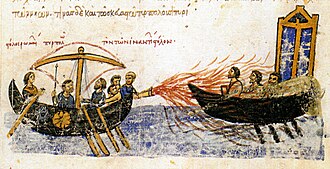
Api Yunani (juga disebut api Bizantium, api Romawi Timur, atau api cair) adalah senjata pembakar yang digunakan oleh Kekaisaran Romawi Timur mulai ca 672. Senjata ini digunakan untuk membakar kapal musuh dan dibuat dari senyawa mudah terbakar yang dipancarkan oleh pelontar api. Beberapa sejarawan berspekulasi bahwa api ini bisa dinyalakan saat kontak dengan air, dan mungkin berbahan dasar nafta serta kapur tohor. Bizantium biasanya menggunakannya dalam pertempuran laut untuk memberikan efek yang besar, karena konon bisa terus terbakar saat mengambang di atas air. Keuntungan teknologi yang diberikannya membawa banyak kemenangan yang diraih Bizantium, terutama keselamatan Konstantinopel dari pengepungan Arab pertama dan kedua, sehingga mengamankan kelangsungan hidup Kekaisaran.[1]
Api Yunani membuat terkesan para tentara Salib Eropa barat, sehingga nama itu kemudian dipakai untuk menyebut segala jenis senjata pembakar, termasuk yang digunakan oleh orang Arab, Tiongkok, dan Mongol. Namun, campuran ini menggunakan formula yang berbeda dari api Yunani Bizantium, yang merupakan rahasia negara yang dijaga ketat. Bizantium juga menggunakan nozel bertekanan untuk memproyeksikan cairan ke musuh, dengan cara yang menyerupai penyembur api modern.[2]
Proses pembuatan cairan ini sangat dirahasiakan militer; begitu rahasia, sampai sekarang pun cara pembuatannya masih belum diketahui. Sumber yang bervariasi berspekulasi bahwa api ini terdiri dari belerang, kapur tohor, dan minyak bumi. Kemungkinan bahan pembuatnya terdiri dari kalsium fosfida, dibuat dengan memanaskan tohor, tulang, dan batu bara. Begitu terkena air kalsium fosfida melepaskan fosfin, yang menyala seketika.
Referensi
suntingKutipan
sunting- ^ Pryor & Jeffreys 2006, hlm. 608–609.
- ^ Forbes 1959, hlm. 83.
Sumber
sunting- al-Hassan, A. Y. (2001), "Alchemy, chemistry and chemical technology", dalam al-Hassan, A. Y. (ed.), Science and Technology in Islam: Technology and applied sciences, UNESCO, hlm. 41–83, ISBN 9231038311
- Cheronis, Nicholas D. (1937), "Chemical Warfare in the Middle Ages: Kallinikos' 'Prepared Fire'", Journal of Chemical Education, 14 (8), Chicago: 360–365, Bibcode:1937JChEd..14..360C, doi:10.1021/ed014p360
- Christides, Vassilios (1991), "Fireproofing of War Machines, Ships and Garments", Proc. Tropis VI: 6th International Symposium on Ship Construction in Antiquity, Lamia 1996, Athens, hlm. 135–141, ISSN 1105-7947 Pemeliharaan CS1: Lokasi tanpa penerbit (link)
- Christides, Vassilios (1993), "Nafṭ", The Encyclopedia of Islam, New Edition, Volume VII: Mif–Naz, Leiden and New York: Brill, hlm. 884–886, ISBN 9004094199.
- Dawes, Elizabeth A., ed. (1928), The Alexiad, London: Routledge & Kegan Paul
- Crosby, Alfred W. (2002), Throwing Fire: Projectile Technology Through History, Cambridge University Press, ISBN 978-0521791588
- Dunning, Brian (17 May 2022). "Skeptoid #832: What Greek Fire Really Was". Skeptoid. Diakses tanggal 20 May 2022.
- Ellis Davidson, Hilda R. (1973), "The Secret Weapon of Byzantium", Byzantinische Zeitschrift, 66: 61–74
- Forbes, R. J. (1959), "Naphtha Goes To War", More Studies in Early Petroleum History 1860–1880, Leiden: E.J. Brill, hlm. 70–90
- Haldon, John; Byrne, Maurice (1977), "A Possible Solution to the Problem of Greek Fire", Byzantinische Zeitschrift, 70: 91–99, doi:10.1515/byzs.1977.70.1.91, S2CID 191489863
- Haldon, John (2006), "'Greek fire' revisited: recent and current research", dalam Jeffreys, Elizabeth (ed.), Byzantine Style, Religion and Civilization: In Honour of Sir Steven Runciman, Cambridge University Press, hlm. 290–325, ISBN 978-0521834452
- Karatolios K., Greek Fire and its contribution to Byzantine might, translated by Leonard G. Meachim (Mytilene 2013) [tanpa ISBN]
- Leicester, Henry Marshall (1971), The historical background of chemistry, Courier Dover Publications, ISBN 978-0486610535
- Moravcsik, Gyula; Jenkins, R.J.H., ed. (1967), Constantine Porphyrogenitus: De Administrando Imperio, Dumbarton Oaks
- Nicolle, David (1996), Medieval Warfare Source Book: Christian Europe and its Neighbours, Brockhampton Press, ISBN 1860198619
- Partington, James Riddick (1999), A History of Greek Fire and Gunpowder, Johns Hopkins University Press, ISBN 0801859549
- Pászthory, Emmerich (1986), "Über das 'Griechische Feuer'. Die Analyse eines spätantiken Waffensystems", Antike Welt, 17 (2): 27–38
- Pryor, John H. (2003), "Byzantium and the Sea: Byzantine Fleets and the History of the Empire in the Age of the Macedonian Emperors, c. 900–1025 CE", dalam Hattendorf, John B.; Unger, Richard W. (ed.), War at Sea in the Middle Ages and the Renaissance, Boydell Press, hlm. 83–104, ISBN 0851159036
- Pryor, John H.; Jeffreys, Elizabeth M. (2006), The Age of the ΔΡΟΜΩΝ: The Byzantine Navy ca. 500–1204, Brill Academic Publishers, ISBN 978-9004151970
- Roland, Alex (1992), "Secrecy, Technology, and War: Greek Fire and the Defense of Byzantium", Technology and Culture, 33 (4): 655–679, doi:10.2307/3106585, JSTOR 3106585
- Spears, W.H. Jr. (1969). Greek Fire: The Fabulous Secret Weapon That Saved Europe. ISBN 0960010637
- Theophanes; Turtledove, Harry (Transl.) (1982), The chronicle of Theophanes: an English translation of anni mundi 6095–6305 (A.D. 602–813), University of Pennsylvania Press, ISBN 978-0812211283
- Thucydides, History of the Peloponnesian War, translated by Rex Warner; with an introduction and notes by M.I. Finley (London 1972)
- Toutain, J. (1953), "Le feu grégeois", Journal des Savants (dalam bahasa Prancis), Paris: 77–80
- "The Rise of Gawain, Nephew of Arthur (De ortu Waluuanii)," ed. Mildred Leake Day, in Wilhelm, James J. (1994). The Romance of Arthur. New York: Garland. pp. 369–397. ISBN 0815315112
- Zenghelis, C. (1932), "Le feu grégeois et les armes à feu des Byzantins", Byzantion, VI, Brussels: 265–286
Pranala luar
sunting

- Greek Fire – World History Encyclopedia
- Technoporn: Greek Fire – Wired Blog, December 29, 2006.
- Greek Fire – The Best Kept Secret of the Ancient World – by Richard Groller.
- Greek Fire – The University of Calgary, 2000. Retrieved on 10 March 2013.
- The Link: Greek Fire – National Geographic, 1 May 2012. Retrieved on 9 Mar 2013.
 | Artikel bertopik senjata ini adalah sebuah rintisan. Anda dapat membantu Wikipedia dengan mengembangkannya. |
