
Pour les autres listes d'étoiles, voir Liste de listes d'étoiles.
Voici une liste d'étoiles connues, ordonnées par taille décroissante.
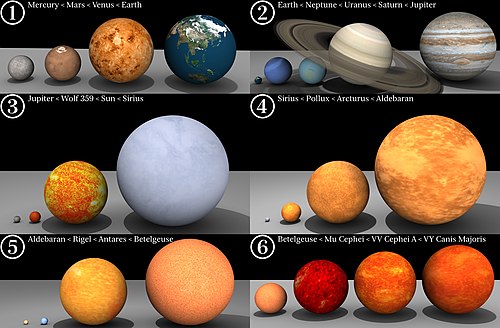
 Les tailles relatives des planètes dans le système solaire et certaines des plus grandes étoiles : |
Critères
modifierL'ordre exact de cette liste n'est encore ni parfaitement défini, ni par conséquent arrêté :
- arbitrairement, la liste se limite aux étoiles dont le rayon dépasse 700 fois celui du Soleil. En outre, la liste établie ci-dessous n'est pas totalement bien définie ; selon les sources :
- des étoiles doubles peuvent être traitées indépendamment ou non ;
- les diamètres donnés varient fortement ;
- il peut exister des incertitudes élevées dans les valeurs et les tailles dérivées ;
- l'incertitude sur les distances à la plupart de ces étoiles varie à des degrés différents et affecte les mesures des dimensions ;
- plusieurs grandes étoiles ont des atmosphères étendues, et sont intégrées dans des coquilles ou des disques de poussière principalement opaques et pulsées, de sorte que leur rayon n'est pas bien déterminé ;
- il existe des raisons théoriques pour s'attendre à ce qu'aucune étoile dans notre galaxie ne soit plus grande qu'environ 2 600 fois le Soleil, en fonction de modèles évolutifs et de la zone d'instabilité de Hayashi. La limite exacte dépend de la métallicité de l'étoile, de sorte que, par exemple, les supergéantes du nuage de Magellan ont une température et une luminosité légèrement différentes. Les étoiles dépassant cette limite ont été considérées comme subissant de grandes éruptions et ont parfois été remarquées pour changer leur type spectral en quelques mois seulement ;
- une analyse des nuages de Magellan a répertorié la plupart des supergéantes rouges et au moins 50 d'entre elles, dans la liste suivante, sont plus grandes que le point critique de 700 rayons solaires. Le rayon le plus important, trouvé ici, est de l'ordre de 1 500 rayons solaires aux éléments d'incertitude près.
Liste
modifierLes rayons des étoiles listées sont donnés en multiples du rayon du Soleil, noté R☉ et égal à 6,957 × 108 m (soit 695 700 km ou 0,004 65 ua) ainsi qu'en unités astronomiques (UA) (149 597 870 700 m).
| Nom d'étoile | Rayon (R☉) (Soleil = 1) |
Notes | ||
|---|---|---|---|---|
| Stephenson 2 DFK 1 | 2 150[1] | |||
| WOH G64 A | 1 540[2] – 1 730[3] | WOH G64 A avait passé d’une variabilité semi-régulière à irrégulière vers 2014, ce qui avait une fois suggéré qu’elle est passée à une hypergéante jaune. Des données récentes indiquent qu’elle est toujours une supergéante rouge, influencée par une étoile compagnon[4]. | ||
| VX Sagittarii | 1 456 – 1 556[5] | La valeur inférieure correspond au rayon moyen pendant le cycle de pulsation au repos, avec une amplitude de 60 rayons solaires, tandis que la valeur supérieure correspond au rayon moyen pendant le cycle de pulsation actif, avec une amplitude de 197 rayons solaires. Atteint un rayon maximal de 1 798 ± 127 rayons solaires en septembre 2019[6]. | ||
| RSGC1-F01 | 1 450[7] – 1 530[8] | |||
| Mu Cephei (Étoile Grenat) | 1 420[9] | |||
| VY Canis Majoris | 1 420[10] | |||
| AH Scorpii | 1 411[5] | AH Sco est variable de près de 3 grandeurs dans la gamme visuelle et environ 20% dans la luminosité totale. La variation de diamètre n'est pas claire car la température est également variable. | ||
| NML Cygni | 1 350[11],[12],[13] | La région poussiéreuse environnante est très complexe, ce qui rend le rayon difficile à déterminer. | ||
| HR 5171 A | 1 315[14] | HR 5171 A est une étoile très déformée dans un système binaire proche, la perte de masse au secondaire. | ||
| SMC 018136 | 1 310[15] | |||
| V354 Cephei | 1 245[11] | Des paramètres très incertains pour une étoile inhabituelle avec une forte émission radio. Le spectre est variable mais apparemment la luminosité n'est pas. | ||
| Westerlund 1-26 | 1 241 ± 40[16] | Masse très incertaine pour une étoile inhabituelle avec une forte émission d'onde radio. Le spectre est variable mais apparemment la luminosité ne l’est pas. | ||
| BI Cygni (en) | 1 240[9] | |||
| S Persei | 1 230[9] | Dans le Double amas de Persée | ||
| PZ Cassiopeiae | 1 190–1 940[9] 1 260–1 340[17] |
La plus grande estimation est due à une mesure inhabituelle de la bande K et considérée comme un artefact d'une erreur de correction de rougissement. Estimation la plus basse est compatible avec d'autres étoiles dans la même enquête et des modèles théoriques, et l'intermédiaire a été obtenu affiner la distance par rapport à cette étoile, et donc ses paramètres. | ||
| EV Carinae | 1 168–2 880 | EV Car est une étoile instable en proie à l'extinction de la poussière. La valeur à gauche est soumise à l'inexactitude et donc pas encore bien définie. | ||
| BC Cygni | 1 140–1 230[9] | |||
| RSGC1-F02 | 1 128[8] | |||
| RW Cephei | 1 100 ± 40[18] | RW Cep est variable à la fois en luminosité (par un facteur d'au moins 3) et en type spectral (observé de G8 à M), et donc probablement aussi en diamètre. Étant donné que le type spectral et la température à la luminosité maximale ne sont pas connus, les dimensions citées ne sont que des estimations. | ||
| RT Carinae | 1 090[9] | |||
| V396 Centauri | 1 070[9] | |||
| CK Carinae | 1 060[9] | |||
| VV Cephei A | 1 050[19]–1 800[20] | VV Cep A est une étoile très déformée dans un système binaire proche. Il y a une perte de masse avec l'étoile secondaire pendant au moins une partie de son orbite. | ||
| V1749 Cygni | 1 040[9] | |||
| KY Cygni | 1 032[21] | |||
| MY Cephei | 1 028[22] – 2 061[23] | |||
| KW Sagittarii | 1 009[5] | |||
| Psi1 Aurigae | 1 000[24] | |||
| NR Vulpeculae | 980[9] | |||
| RW Cygni | 980[9] | |||
| V381 Cephei | 977[11] | |||
| UY Scuti | 909[5] | |||
| Trumpler 27-1 | 876[25] | |||
| V602 Carinae | 860[9] | |||
| TZ Cassiopeiae | 800[9] | |||
| IX Carinae | 790[9] | |||
| SU Persei | 780[9] | Dans le Double amas de Persée | ||
| V355 Cephei | 770[9] | |||
| RS Persei | 770 ± 30[26] | Dans le Double amas de Persée | ||
| V382 Carinae | 747 | |||
| Eta Carinae (Tseen She) | 742[27] | Auparavant considérée comme l'étoile la plus massive, Eta Carinae s'est révélée être, en 2005, un système binaire. Cette estimation du rayon utilise les mêmes critères que celle du Soleil, où la profondeur optique est de 2/3[27] | ||
| R Leporis | 710–910[28] | |||
| XX Persei | 710 | Dans le Double amas de Persée | ||
| Rho Cassiopeiae | 700[29] (345–773)[30] | |||
| TV Geminorum | 620–770[9] | |||
| Les étoiles suivantes bien connues sont listées à des fins de comparaison. | ||||
| Antarès (Alpha Scorpii) | 680[31] | |||
| DU Crucis | 664[11] | Dans l'amas NGC 4755 | ||
| Bételgeuse (Alpha Orionis) | 640[32] | Neuvième étoile la plus brillante du ciel nocturne ; ce rayon est valable avant et après le grand épisode d'assombrissement de 2020. | ||
| NO Aurigae | 630 | |||
| R Horologii | 630[33] | |||
| 119 Tauri | 587–593[34] | |||
| CW Leonis | 560[35] | |||
| V509 Cassiopeiae | 511 ± 112[29] | |||
| HR Carinae B | 500 ± 150[36] | |||
| R Andromedae | 485 ± 125 | |||
| R Hydrae | 460–631 | |||
| W Hydrae | 436[37] | |||
| Godzilla (en) | 430—2 365[38] | Située à près de 11 milliards d'années-lumière de la Terre, cette hypergéante bleue est actuellement l'étoile la plus lumineuse observée[38]. | ||
| Étoile du Pistolet | 420[39] | |||
| V810 Centauri | 420[40] | |||
| S Orionis | 411–498[41] | |||
| V838 Monocerotis | 380 ± 90 [42] | V838 Mon est un nouveau type d'objet connu comme un Rouge Lumineux Nova. Une fois complété à la liste comme l'une des plus grandes étoiles, après avoir connu une explosion nova progressivement diminué en taille[43]. | ||
| S Doradus | 380[44] | |||
| U Orionis | 370 ± 96 | |||
| Mira A (Omicron Ceti) | 332–402[45] | |||
| Epsilon Aurigae A (Almaaz) | 143–358 | |||
| R Leonis | 320–350[46] | |||
| V337 Carinae | 350 | |||
| T Cephei | 329[47] | |||
| Chi Cygni | 316 (348–480)[48] | |||
| S Coronae Borealis | 308 | |||
| La Superba (Y Canum Venaticorum) | 307 | |||
| R Doradus | 298 ± 21[49] | |||
| Pi Puppis | 290 | |||
| Alpha Herculis (Ras Algethi) | 264–303 | |||
| Omicron1 Canis Majoris | 280 | |||
| S Pegasi | 278–316[50] | |||
| R Cassiopeiae | 263 | |||
| Cygnus OB2-12 | 246 | |||
| HR Carinae A | 220 ± 60[36] | |||
| Delta Canis Majoris (Wezen) | 215 ± 66[51] | |||
| Deneb | 203 | |||
| LBV 1806-20 | 200 | |||
| Zeta Aurigae (Haedus) | 200[52] | |||
| Delta2 Lyrae | 200 | |||
| Lambda Velorum (Al Suhail) | 200 | |||
| RS Puppis | 200 | |||
| Epsilon Pegasi (Enif) | 185 | |||
| L Carinae | 179 | |||
| 6 Cassiopeiae | 170 | |||
| Rho Persei (Gorgonea Tertia) | 164 | |||
| Var 83 | 150[53] | |||
| Gamma Cygni (Sadir) | 150 | |||
| Epsilon Geminorum (Mebsuta) | 140 | |||
| Mu Bootis (Alkalurops) | 130 | |||
| 66 Andromedae | 130 | |||
| QS Aquilae | 130 | |||
| 56 Aquilae | 130 | |||
| L2 Puppis | 126 | |||
| Iota Scorpii (Apollyon) | 125 | |||
| Delta Apodis | 125 | |||
| HIP 110307 | 124.1 | |||
| 32 G. Hydrae | 121.7 | |||
| I Carinae | 120 | |||
| Xi Puppis (Asmidiske) | 120 | |||
| Mu Sagittarii (Polis) | 115 | |||
| Omicron Cygni | 115 | |||
| V533 Carinae | 114 | |||
| Gamma Crucis (Gacrux) | 84–113[54] | |||
| Zeta Cephei | 110 | |||
| Gamma Aquilae (Tarazed) | 110 | |||
| 34 Bootis | 110 | |||
| Beta Arae | 110 | |||
| Atria (Alpha Trianguli Australis) | 109 | |||
| Beta Cygni A1 (Albireo) | 69–109 | |||
| WR 102ka (Étoile pivoine) | 100 | |||
| Beta Pegasi (Scheat) | 95 | |||
| 17 Camelopardalis | 91.3 | |||
| Beta Andromedae (Mirach) | 90 | |||
| R Scuti | 84 | |||
| Nu Cephei | 83.5 | |||
| Gamma Andromedae (Almach) | 83 | |||
| Theta Herculis (Rukbalgethi Genubi) | 80 | |||
| Rigel (Beta Orionis) | 78,9 | |||
| Alpha Leporis (Arneb) | 77 | |||
| P Cygni | 76 | |||
| Beta Doradus | 76 | |||
| DL Crucis | 75-80 | |||
| Pi Herculis | 72 | |||
| Canopus (Alpha Carinae) | 71,4 | |||
| 13 Bootis | 71 | |||
| Epsilon Carinae (Avior) | 153 | |||
| 62 Sagittarii | 70 | |||
| Nu Aquilae (Equator Star)[réf. nécessaire] | 66 | |||
| R Coronae Borealis | 65 | |||
| Delta Virginis (Auva) | 65 | |||
| Delta Sagittarii (Kaus Media) | 62 | |||
| Alpha Persei (Mirfak) | 60 | |||
| Zeta Geminorum (Mekbuda) | 60 | |||
| Eta Aquilae (Bezek)[réf. nécessaire] | 60 | |||
| 89 Herculis | 60 | |||
| Upsilon Sagittarii | 60 | |||
| Alpha Aquarii (Sadalmelik) | 60 | |||
| CPD -572874 | 60 | |||
| Chi Orionis | 59 | |||
| Alpha Persei (Mirfak) | 56 | |||
| Iota Aurigae (Al Kab) | 55 | |||
| FF Aquilae | 55 | |||
| Alpha Apodis | 55 | |||
| Tau Serpentis | 54 | |||
| Beta Cancri (Tarf) | 53 | |||
| Alpha Antliae | 53 | |||
| Zeta1 Scorpii | 52 | |||
| Alphard (Alpha Hydrae) | 50,5 | |||
| Gamma Draconis (Eltanin) | 50 | |||
| Beta Aquarii (Sadalsuud) | 50 | |||
| HD 5980 A | 48-160 | |||
| Epsilon Bootis (Izar) | 48 | |||
| Zeta2 Scorpii | 48 | |||
| AG Antliae | 47 | |||
| V428 Andromedae | 46,3 | |||
| HD 13189 | 46 | |||
| HD 203857 | 46 | |||
| Aldébaran (Alpha Tauri) | 44.2[55] | |||
| Alpha Cassiopeiae (Schedar) | 42 | |||
| Alpha Ceti (Menkar) | 42 | |||
| Delta Cephei (Alrediph)[réf. nécessaire] | 41,6 | |||
| Beta Ursae Minoris (Kochab) | 41 | |||
| Beta Draconis (Rastaban) | 40 | |||
| BD Camelopardalis | 40 | |||
| HD 5980 B | 40 | |||
| Eta Canis Majoris (Aludra) | 37,8 | |||
| Polaris (Alpha Ursae Minoris) | 37,5-46 | |||
| 87 Leonis | 37 | |||
| Gamma Centauri (Muhlifan) | 36,5 | |||
| S Normae | 35,6 | |||
| R136a1 | 28,8-35,4 | Également enregistrée comme l'étoile la plus massive et la plus lumineuse connue. | ||
| Sher 25 | 35 | |||
| Gamma Leonis (Algieba) | 31,9 | |||
| Alpha Camelopardalis | 31,2 | |||
| Alpha Ursae Majoris (Dubhe) | 30 | |||
| 11 Lacertae | 30 | |||
| Beta Camelopardalis | 30 | |||
| Cygnus OB2-8A | 28 | |||
| Eta Leonis (Al Jabhah) | 27 | |||
| WR 102ea (Archen Star)[réf. nécessaire] | 27 | |||
| R Apodis | 26,3 | |||
| Epsilon Orionis (Alnilam) | 26 | |||
| Eta Piscium (Kullat Nunu) | 26 | |||
| Melnick 42 | 26 | |||
| Arcturus (Alpha Bootis) | 25,7 | |||
| HD 93129A | 25 | |||
| 11 Ursae Minoris | 24,1 | |||
| HD 47536 | 23.5 | |||
| Epsilon Leonis (Algenubi) | 23 | |||
| 42 Draconis | 22 ± 1 | |||
| Alpha Reticuli | 21 | |||
| Chi Virginis | 20,9 | |||
| 19 Cephei | 20–30 | |||
| HDE 226868 | 20-22 | Le compagnon supergéant de Cygnus X-1. | ||
| Zeta Orionis (Alnitak) | 20 | |||
| Theta Scorpii (Sargas) | 20 | |||
| Beta Herculis (Kornephoros) | 20 | |||
| Theta Apodis | 20 | |||
| Alpha Sagittae (Alsahm) | 20 | |||
| Westerlund 2 | 19,3 | |||
| Étoile de Plaskett | 19,2 | |||
| Kappa Cassiopeiae | 19 | |||
| Beta Scorpii (Acrab) | 19 | |||
| Beta Lyrae (Sheliak) | 19 | |||
| Zeta Puppis (Naos) | 18,6 | |||
| R 122 | 18,5 | |||
| HD 93250 | 18 | |||
| Alpha Microscopii | 17,5 | |||
| LH45-425 A | 17,5 | |||
| Upsilon Hydrae | 17,1 | |||
| Beta Ceti (Deneb Kaitos) | 17 | |||
| Epsilon Canis Majoris (Adhara) | 17 | |||
| VV Cephei B | 14-20 | |||
| LY Aurigae | 16 | |||
| Theta Centauri (Menkent) | 16 | |||
| Beta Corvi (Kraz) | 16 | |||
| Delta Orionis A (Mintaka) | 15,8 | |||
| Nu Ophiuchi (Sinistra) | 15,25 | |||
| Alpha Arietis (Hamal) | 14-15 | |||
| ... | ||||
| Soleil | 1 | |||
Notes et références
modifierNotes
modifier
Références
modifier- ↑ Thomas K. T Fok, Jun-ichi Nakashima, Bosco H. K Yung, Chih-Hao Hsia et Shuji Deguchi, « Maser Observations of Westerlund 1 and Comprehensive Considerations on Maser Properties of Red Supergiants Associated with Massive Clusters », The Astrophysical Journal, vol. 760, no 1, 2012, p. 65 (DOI 10.1088/0004-637X/760/1/65, Bibcode 2012ApJ...760...65F, arXiv 1209.6427, S2CID 53393926)
- ↑ Emily M Levesque, Philip Massey, Bertrand Plez et Knut A. G Olsen, « The Physical Properties of the Red Supergiant WOH G64: The Largest Star Known? », Astronomical Journal, vol. 137, no 6, juin 2009, p. 4744 (DOI 10.1088/0004-6256/137/6/4744, Bibcode 2009AJ....137.4744L, arXiv 0903.2260)
- ↑ K. Ohnaka, T. Driebe, K. H. Hofmann, G. Weigelt et M. Wittkowski, « Resolving the dusty torus and the mystery surrounding LMC red supergiant WOH G64 », Proceedings of the International Astronomical Union, vol. 4, juillet 2008, p. 454–458 (DOI 10.1017/S1743921308028858, Bibcode 2009IAUS..256..454O)
- ↑ Jacco Th van Loon et Keiichi Ohnaka, « A phoenix rises from the ashes: WOH G64 is still a red supergiant, for now », Monthly Notices of the Royal Astronomical Society, 5 janvier 2026 (arXiv 2601.02057)
- B Arroyo-Torres, M Wittkowski, J. M Marcaide et P. H Hauschildt, « The atmospheric structure and fundamental parameters of the red supergiants AH Scorpii, UY Scuti, and KW Sagittarii », Astronomy & Astrophysics, vol. 554, no A76, juin 2013, A76 (DOI 10.1051/0004-6361/201220920, Bibcode 2013A&A...554A..76A, arXiv 1305.6179)
- ↑ D. Jadlovský, M. Wittkowski, A. Chiavassa, K. Kravchenko, B. Freytag, S. Höfner, J. Krtička, C. Paladini et G. Rau, « VLTI-GRAVITY measurements of cool evolved stars: II. Pulsation properties and mass-loss process of the Mira star R Car and the red supergiant VX Sgr », Astronomy and Astrophysics, 23 avril 2026 (arXiv 2604.21621)
- ↑ Leen Decin, Anita M. S. Richards, Pablo Marchant et Hugues Sana, ALMA detection of CO rotational line emission in red supergiant stars of the massive young star cluster RSGC1 -- Determination of a new mass-loss rate prescription for red supergiants, 13 novembre 2023 (DOI 10.48550/arXiv.2303.09385, lire en ligne)
- Roberta M. Humphreys, Greta Helmel, Terry J. Jones et Michael S. Gordon, Exploring the Mass Loss Histories of the Red Supergiants, 3 août 2020 (DOI 10.48550/arXiv.2008.01108, lire en ligne)
- Table 4 dans (en-US) Emily M. Levesque, Philip Massey, K. A. G. Olsen, Bertrand Plez, Eric Josselin, Andre Maeder, and Georges Meynet, « The Effective Temperature Scale of Galactic Red Supergiants: Cool, but Not As Cool As We Thought », The Astrophysical Journal, vol. 628, no 2, août 2005, p. 973–985 (DOI 10.1086/430901, Bibcode 2005ApJ...628..973L, arXiv astro-ph/0504337)
- ↑ M. Wittkowski, P. H. Hauschildt, B. Arroyo-Torres et J. M. Marcaide, « Fundamental properties and atmospheric structure of the red supergiant VY Canis Majoris based on VLTI/AMBER spectro-interferometry », Astronomy & Astrophysics, vol. 540, 2012, p. L12 (DOI 10.1051/0004-6361/201219126, Bibcode 2012A&A...540L..12W, arXiv 1203.5194)
- (en) Sarah Healy, Shunsaku Horiuchi, Marta Colomer Molla et Dan Milisavljevic, « Red supergiant candidates for multimessenger monitoring of the next Galactic supernova », Monthly Notices of the Royal Astronomical Society, vol. 529, no 4, 23 mars 2024, p. 3630–3650 (ISSN 0035-8711 et 1365-2966, DOI 10.1093/mnras/stae738, lire en ligne, consulté le 23 novembre 2025)
- ↑ J. D. Monnier et al., « High-Resolution Imaging of Dust Shells by Using Keck Aperture Masking and the IOTA Interferometer », The Astrophysical Journal, vol. 605, 2004, p. 436–461 (résumé)
- ↑ Calculé en utilisant le diamètre angulaire moyen de 7,8 millisecondes (de CHARM2) et la distance de environ 1,61 kpc (∼5 250 al) (de Zhang (2012)). L'équation est : , où est le diamètre angulaire, est la distance et est le diamètre, dans des unités astronomiques. Se multipliera par 107,5 pour convertir de UA en radio solaire.
- ↑ O. Chesneau, A. Meilland, E. Chapellier et F. Millour, The yellow hypergiant HR 5171 A: Resolving a massive interacting binary in the common envelope phase, 14 janvier 2014 (DOI 10.48550/arXiv.1401.2628, lire en ligne)
- ↑ (en) E. M. Levesque, P. Massey, K. A. G. Olsen, B. Plez, G. Meynet et A. Maeder, « The Effective Temperatures and Physical Properties of Magellanic Cloud Red Supergiants: The Effects of Metallicity », The Astrophysical Journal, vol. 645, no 2, 2006, p. 1102 (DOI 10.1086/504417, Bibcode 2006ApJ...645.1102L, arXiv astro-ph/0603596)
- ↑ (en) Aura de Las Estrellas Ramírez Arévalo, « The Red Supergiants in the Supermassive Stellar Cluster Westerlund 1 », teses.usp.br, Universidade de São Paulo, 12 juillet 2018 (DOI 10.11606/d.14.2019.tde-12092018-161841, lire en ligne, consulté le 23 novembre 2025)
- ↑ DOI 10.1088/0004-637X/774/2/107
- ↑ Narsireddy Anugu, Douglas R. Gies, Rachael M. Roettenbacher et John D. Monnier, Time-Evolution Images of the Hypergiant RW Cephei During the Re-brightening Phase Following the Great Dimming, 21 août 2024 (DOI 10.48550/arXiv.2408.11906, lire en ligne)
- ↑ Wendy Hagen Bauer, Theodore R. Gull et Philip D. Bennett, « SPATIAL EXTENSION IN THE ULTRAVIOLET SPECTRUM OF VV CEPHEI », The Astronomical Journal, vol. 136, no 3, 1er septembre 2008, p. 1312–1324 (ISSN 0004-6256 et 1538-3881, DOI 10.1088/0004-6256/136/3/1312, lire en ligne)
- ↑ (en) C. Moellenhoff et K. Schaifers, « Spectroscopic observations of VV Cep. », Astronomy and Astrophysics, vol. 94, février 1981, p. 333–337 (ISSN 0004-6361, lire en ligne, consulté le 8 décembre 2025)
- ↑ F. Comerón, A. A. Djupvik, N. Schneider et A. Pasquali, « The historical record of massive star formation in Cygnus », Astronomy & Astrophysics, vol. 644, octobre 2020, A62 (DOI 10.1051/0004-6361/202039188, lire en ligne)
- ↑ Maria Messineo, Donald F. Figer, Rolf-Peter Kudritzki, Qingfeng Zhu, Karl M. Menten, Valentin D. Ivanov et C. -H. Rosie Chen, « New Infrared Spectral Indices of Luminous Cold Stars: From Early K to M Types », The Astronomical Journal, vol. 162, 2021, p. 187 (DOI 10.3847/1538-3881/ac116b, lire en ligne, consulté le 29 mars 2026)
- ↑ Roberta M. Humphreys, Greta Helmel, Terry J. Jones et Michael S. Gordon, « Exploring the Mass Loss Histories of the Red Supergiants », The Astronomical Journal, vol. 160, no 3, 2 septembre 2020, p. 145 (ISSN 1538-3881, DOI 10.3847/1538-3881/abab15, lire en ligne, consulté le 28 mai 2022)
- ↑ (en) Daisuke Taniguchi, Noriyuki Matsunaga, Mingjie Jian et Naoto Kobayashi, « Effective temperatures of red supergiants estimated from line-depth ratios of iron lines in the YJ bands, 0.97-1.32μm », Monthly Notices of the Royal Astronomical Society, vol. 502, no 3, 28 février 2021, p. 4210–4226 (ISSN 0035-8711 et 1365-2966, DOI 10.1093/mnras/staa3855, lire en ligne, consulté le 23 novembre 2025)
- ↑ Gaia Collaboration, A. Vallenari, A. G. A. Brown et T. Prusti, Gaia Data Release 3: Summary of the content and survey properties, 30 juillet 2022 (DOI 10.48550/arXiv.2208.00211, lire en ligne)
- ↑ F. Baron, J. D. Monnier, L. L. Kiss et H. R. Neilson, CHARA/MIRC observations of two M supergiants in Perseus OB1: temperature, Bayesian modeling, and compressed sensing imaging, 11 juin 2014 (DOI 10.48550/arXiv.1405.4032, lire en ligne)
- « Eta Carinae: An Evolving View of the Central Binary, Its Interacting Winds and Its Foreground Ejecta », The Astrophysical Journal, vol. 933, no 2, 1er juillet 2022, p. 175 (ISSN 0004-637X et 1538-4357, DOI 10.3847/1538-4357/ac74c2, lire en ligne)
- ↑ Yoshiharu Asaki, Luke T. Maud, Harold Francke et Hiroshi Nagai, ALMA High-frequency Long Baseline Campaign in 2021: Highest Angular Resolution Submillimeter Wave Images for the Carbon-rich Star R Lep, 18 octobre 2023 (DOI 10.48550/arXiv.2310.09664, lire en ligne)
- Narsireddy Anugu, Fabien Baron, John D. Monnier et Douglas R. Gies, CHARA Near-Infrared Imaging of the Yellow Hypergiant Star $ρ$ Cassiopeiae: Convection Cells and Circumstellar Envelope, 7 août 2024 (DOI 10.48550/arXiv.2408.02756, lire en ligne)
- ↑ (en) A. M. van Genderen, A. Lobel, R. Timmerman et E. R. Deul, « Investigation of the pulsations, outbursts, and evolution of the yellow hypergiants - ρ Cas, HR 8752, and HR 5171A, with notes on HD 179821 », Astronomy & Astrophysics, vol. 694, 1er février 2025, A136 (ISSN 0004-6361 et 1432-0746, DOI 10.1051/0004-6361/202449384, lire en ligne, consulté le 23 novembre 2025)
- ↑ Keiichi Ohnaka, Karl-Heinz Hofmann, Dieter Schertl et Gerd Weigelt, High spectral resolution imaging of the dynamical atmosphere of the red supergiant Antares in the CO first overtone lines with VLTI/AMBER, 30 avril 2013 (DOI 10.48550/arXiv.1304.4800, lire en ligne)
- ↑ M. Mittag, K.-P. Schröder, V. Perdelwitz et D. Jack, Chromospheric activity and photospheric variation of $α$ Ori during the great dimming event in 2020, 9 novembre 2022 (DOI 10.48550/arXiv.2211.04967, lire en ligne)
- ↑ Taissa Danilovich, D. Teyssier, K. Justtanont et H. Olofsson, New observations and models of circumstellar CO line emission of AGB stars in the Herschel SUCCESS programme, 1er juillet 2015 (DOI 10.48550/arXiv.1506.09065, lire en ligne)
- ↑ M. Montargès, R. Norris, A. Chiavassa et B. Tessore, The convective photosphere of the red supergiant CE Tau. I. VLTI/PIONIER H-band interferometric imaging, 16 février 2018 (DOI 10.48550/arXiv.1802.06086, lire en ligne)
- ↑ M. R. Schmidt, J. H. He, R. Szczerba et V. Bujarrabal, « Herschel/HIFI observations of the circumstellar ammonia lines in IRC+10216 », Astronomy and Astrophysics, vol. 592, août 2016, A131 (ISSN 0004-6361, PMID 28065983, PMCID 5217166, DOI 10.1051/0004-6361/201527290, lire en ligne, consulté le 23 novembre 2025)
- Henri M. J. Boffin, Thomas Rivinius, Antoine Merand et Andrea Mehner, The LBV HR Car has a partner: Discovery of a companion with the VLTI, 26 juillet 2016 (DOI 10.48550/arXiv.1607.07724, lire en ligne)
- ↑ K. Ohnaka, K. T. Wong, G. Weigelt et K.-H. Hofmann, Contemporaneous high-angular-resolution imaging of the AGB star W Hya in vibrationally excited H2O lines and visible polarized light with ALMA and VLT/SPHERE-ZIMPOL, 14 novembre 2024 (DOI 10.48550/arXiv.2411.09759, lire en ligne)
- J. M. Diego, M. Pascale, B. J. Kavanagh et P. Kelly, Godzilla, a monster lurks in the Sunburst galaxy, 15 mars 2022 (DOI 10.48550/arXiv.2203.08158, lire en ligne)
- ↑ Ryan M. Lau, Terry L. Herter, Mark R. Morris et Joseph D. Adams, Nature Versus Nurture: Luminous Blue Variable Nebulae in and near Massive Stellar Clusters at the Galactic Center, 20 mars 2014 (DOI 10.48550/arXiv.1403.5298, lire en ligne)
- ↑ (en) « V810 Centauri », sur jumk.de (consulté le 19 avril 2023).
- ↑ M. Wittkowski, D. A. Boboltz, K. Ohnaka et T. Driebe, The Mira variable S Ori: Relationships between the photosphere, molecular layer, dust shell, and SiO maser shell at 4 epochs, 31 mai 2007 (DOI 10.48550/arXiv.0705.4614, lire en ligne)
- ↑ (en-US) B. F. Lane, A. Retter, R. R. Thompson, J. A. Eisner, « Interferometric Observations of V838 Monocerotis », The Astrophysical Journal Letters, vol. 622, no 2, avril 2005, L137–L140 (DOI 10.1086/429619, Bibcode 2005ApJ...622L.137L, arXiv astro-ph/0502293)
- ↑ DOI 10.1051/0004-6361/201116858
- ↑ (en-US) H. J. G. L. M. Lamers, « Observations and Interpretation of Luminous Blue Variables », ASP Conference Series, vol. 83, february 6–10, 1995, p. 176–191 (Bibcode 1995ASPC...83..176L)
- ↑ http://www.eso.org/~mwittkow/publications/conferences/SPIECWo5491199.pdf
- ↑ (en-US) Fedele, Wittkowski, Paresce, Scholz, Wood et Ciroi, « The K-band intensity profile of R Leonis probed by VLTI/VINCI », Astronomy and Astrophysics, vol. 431, no 3, 2004, p. 1019–1026 (DOI 10.1051/0004-6361:20042013, Bibcode 2005A&A...431.1019F, arXiv astro-ph/0411133)
- ↑ Gerd Weigelt, Udo Beckmann, Jean-Philippe Berger et Thomas Bloecker, « JHK-band spectro-interferometry of T Cep with the IOTA interferometer », DOI.org (Crossref), 24 février 2003, p. 181 (DOI 10.1117/12.458659, lire en ligne, consulté le 23 novembre 2025)
- ↑ « VizieR », sur u-strasbg.fr (consulté le 19 avril 2023).
- ↑ Keiichi Ohnaka, Gerd Weigelt et Karl-Heinz Hofmann, « Infrared Interferometric Three-dimensional Diagnosis of the Atmospheric Dynamics of the AGB Star R Dor with VLTI/AMBER* », The Astrophysical Journal, vol. 883, no 1, 20 septembre 2019, p. 89 (ISSN 0004-637X et 1538-4357, DOI 10.3847/1538-4357/ab3d2a, lire en ligne)
- ↑ E. Béguin, A. Chiavassa, A. Ahmad et B. Freytag, Retrieving stellar parameters and dynamics of AGB stars with Gaia parallax measurements and CO5BOLD RHD simulations, 5 septembre 2024 (DOI 10.48550/arXiv.2409.03422, lire en ligne)
- ↑ (en-US) J. Davis J, Booth AJ, Ireland MJ, Jacob AP, North JR, Owens SM, Robertson JG, Tango WJ, Tuthill PG, A. J. Booth, M. J. Ireland, A. P. Jacob, J. R. North, S. M. Owens, J. G. Robertson, W. J. Tango et P. G. Tuthill, « The Emergent Flux and Effective Temperature of Delta Canis Majoris », Publications of the Astronomical Society of Australia, vol. 24, no 3, 2007, p. 151 (DOI 10.1071/AS07017, Bibcode 2007PASA...24..151D, arXiv 0709.3873)
- ↑ « http://www.hposoft.com/EAur09/ZetaAurigae.html »(Archive.org • Wikiwix • Google • Que faire ?) (consulté le 2 août 2017)
- ↑ (en) A. F. Valeev, O. Sholukhova et S. Fabrika, « A new luminous variable in M33 », Monthly Notices of the Royal Astronomical Society: Letters, vol. 396, no 1, 1er juin 2009, L21–L25 (ISSN 1745-3933 et 1745-3925, DOI 10.1111/j.1745-3933.2009.00654.x, lire en ligne, consulté le 23 novembre 2025)
- ↑ Gamma Crucis by Jim Kaler
- ↑ (en-US) Richichi, A. et Roccatagliata, V., « Aldebaran's angular diameter: how well do we know it? », Astronomy and Astrophysics, vol. 433, 2005, p. 305–312 (DOI 10.1051/0004-6361:20041765, Bibcode 2005A&A...433..305R, arXiv astro-ph/0502181)


Voir aussi
modifierArticles connexes
modifier- Étoile
- Liste de listes d'étoiles
- Image comparant la tailles de diverses étoiles et de planètes du système solaire (autre version)
Liens externes
modifier- Giant Stars, site interactif de comparaison de la Terre et du Soleil à certaines des plus grandes étoiles connues
- Les astronomes du Lowell Observatory identifient les plus grandes étoiles connues
- Identification de trois des plus grandes étoiles sur BBC News
- Quelle est la plus grande étoile de l'univers sur Universe Today


