This article has multiple issues. Please help improve it or discuss these issues on the talk page. (Learn how and when to remove these messages)
|
In mathematics, a generalized arithmetic progression (or multiple arithmetic progression) is a generalization of an arithmetic progression equipped with multiple common differences – whereas an arithmetic progression is generated by a single common difference, a generalized arithmetic progression can be generated by multiple common differences. For example, the sequence is not an arithmetic progression, but is instead generated by starting with 17 and adding either 3 or 5, thus allowing multiple common differences to generate it. A semilinear set generalizes this idea to multiple dimensions – it is a set of vectors of integers, rather than a set of integers.

Finite generalized arithmetic progression
editA finite generalized arithmetic progression, or sometimes just generalized arithmetic progression (GAP), of dimension d is defined to be a set of the form where .[1] The product is called the size of the generalized arithmetic progression; the cardinality of the set can differ from the size if some elements of the set have multiple representations. If the cardinality equals the size, the progression is called proper. Generalized arithmetic progressions can be thought of as a projection of a higher dimensional grid into . This projection is injective if and only if the generalized arithmetic progression is proper.




Semilinear sets
editFormally, an arithmetic progression of is an infinite sequence of the form , where and are fixed vectors in , called the initial vector and common difference respectively. A subset of is said to be linear if it is of the form where is some integer and are fixed vectors in . A subset of is said to be semilinear if it is a finite union of linear sets.




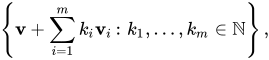


The semilinear sets are exactly the sets definable in Presburger arithmetic.[2][3]
See also
editNotes and references
edit- ^ Tao & Vu 2006, p. xvii, Definition 0.2 (Progressions). Tao and Vu work in an arbitrary additive group and write the progression as where and the box contains points. This agrees with the definition given here upon setting ; they call the rank rather than the dimension.
- ^ Ginsburg & Spanier 1966.
- ^ See also: Haase 2018, 4. SEMI-LINEAR SETS
![{\displaystyle P=a+[0,N]\cdot v,}](https://wikimedia.org/api/rest_v1/media/math/render/svg/fc1570ed09d01804ca97eb618ab6204f752de502)

![{\displaystyle [0,N]}](https://wikimedia.org/api/rest_v1/media/math/render/svg/703d57dca548a7f9d927247c2a27b67666aebdd5)


Bibliography
edit- Ginsburg, Seymour; Spanier, Edwin Henry (1966). "Semigroups, Presburger Formulas, and Languages". Pacific Journal of Mathematics. 16 (2): 285–296. doi:10.2140/pjm.1966.16.285.
- Haase, Christoph (2018). "A Survival Guide to Presburger Arithmetic" (PDF). ACM SIGLOG News. 5 (3): 67–82. doi:10.1145/3242953.3242964. S2CID 51847374.
- Nathanson, Melvyn B. (1996). Additive Number Theory: Inverse Problems and Geometry of Sumsets. Graduate Texts in Mathematics. Vol. 165. Springer. ISBN 0-387-94655-1. Zbl 0859.11003.
- Tao, Terence; Vu, Van H. (2006). "Additive geometry". Additive Combinatorics. Cambridge University Press. ISBN 9780521853866.
