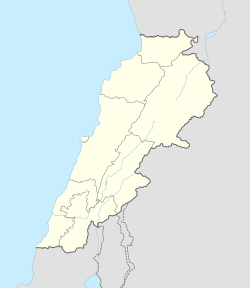

Tempat-tempat yang terkait dengan takhta-takhta Astarte
Takhta Astarte adalah selusin takhta persembahan nazar "kerub" yang ditemukan di kuil-kuil Fenisia di Lebanon, khususnya di daerah sekitar Sidon, Tirus, dan Ummul 'Amad.[1] Banyak dari takhta memiliki gaya yang sama, dengan kepala kerub pada tubuh singa bersayap di kedua sisinya.[2] Gambar takhta ditemukan di situs Fenisia di sekitar pesisir Laut Tengah, termasuk plakat gading dari Tel Megiddo (Israel), sebuah relief dari Hadrumetum (Tunisia), dan skarab dari Tharros (Italia).[2]
Daftar takhta
sunting| Gambar | Periode | Letak penemuan | Disimpan di | Tulisan | Penjelasan | Pertama dipajang |
|---|---|---|---|---|---|---|
 |
Helenistik | Byblos | Museum Nasional Beirut | tidak ada | Di bagian depan, dua sosok menuangkan persembahan ke dalam bunga. Di takhta, anatirosis persegi panjang untuk menempatkan objek.[3] | Dunand[4] |
 |
Helenistik | Sidon | Museum Nasional Beirut | tidak ada | Di bagian depan, palmet Fenisia. Di kursi, tanggam persegi panjang besar digunakan untuk memperbaiki objek. Sandaran tanpa hiasan.[3] | 1941 Dunand[5] |
 |
Romawi | Sidon | Museum Nasional Beirut | Yunani | Kursi sangat miring, tidak mampu menahan benda. Bagian belakang menunjukkan bola dunia di dalam bulan sabit.[3] | 1924[6] |
 |
Sidon | Louvre | tidak ada | Naiskos yang merupakan singgasana dengan dua sfinks. Di atas kursi, rongga berbentuk U, dimaksudkan untuk menerima benda bulat di bagian bawah: mungkin baitulos dan mahkotanya. Di sisi wajah, relief imam yang memimpin.[3] | 1933[7] | |
 |
Sidon | Museum Arkeologi Istanbul | tidak ada | Naiskos sepadan dengan yang sebelumnya. Di bagian belakang terdapat rongga kecil yang dimaksudkan untuk menampung suatu benda. Di samping, dewi bersayap gaya Mesir.[3] | [8] | |
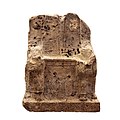 |
abad ke-2 SM | Khirbet et-Tayibeh, dekat Ras al-Ain dekat Tirus | Louvre | Fenisia (KAI 17) | Di singgasana, dua stele dengan relief, menggambarkan dua pejabat yang berdiri.[3] | 1907 Ronzevalle[9][10][11] |
 |
Helenistik | Ayin Baal dekat Tirus | Museum Nasional Beirut | tidak ada | Kursi berisi stele atau baitulos[3] | |
 |
Helenistik | Daerah Tirus | Museum Nasional Beirut | tidak ada | Kursi berisi stele atau baitulos[3] | |
 |
abad ke-4 SM | Ummul 'Amad | Louvre | tidak ada | Di bagian depan, palmet Fenisia[3] | 1860, Renan[12] |
 |
Ummul 'Amad | Museum Nasional Beirut | tidak ada | Bagian depan rusak. Kursi memanjang, depan membulat. Sandaran tanpa hiasan. Takhta besar yang bisa muat seseorang.[3] | Dunand | |
 |
Kuil Esymun | Kuil Esymun | tidak ada | Dunand | ||
 |
Kuil Esymun | Museum Nasional Beirut | tidak ada | Dunand | ||
 |
Helenistik | tidak diketahui | Museum Nasional Beirut | tidak ada |
Galeri
sunting-
![Takhta serupa digambarkan di sarkofagus Ahiram[13]](https://upload.wikimedia.org/wikipedia/commons/thumb/2/28/Ahiram.jpg/120px-Ahiram.jpg) Takhta serupa digambarkan di sarkofagus Ahiram[13]
Takhta serupa digambarkan di sarkofagus Ahiram[13] -
 KAI 17 (foto)
 -
 KAI 17 (salinan)
 -
 Plakat gading dengan Takhta Astarte
 -
 Patung Punik dari Tunisia (Sanctuaire de Thinissut)
 -
 Skarab dengan Takhta Astarte
Referensi
suntingCatatan kaki
sunting- ^ Milik, 1967
- ^ a b Davila and Zuckerman (1993), p.77: "Compare the votive throne discovered at Umm el-'Amed (Dunand and Duru 1962: 168 pl. 67). The lower part of the throne is badly damaged, but the heads are preserved. The heads are human, and each bears a head-dress or coiffure that reaches down to the shoulders. They also have stylized beards. On our throne, what remains of the headdresses/coiffures and beards of the cherubs stylistically parallels those of the Umm el-'Amed cherubs. In fact, it seems quite probable that they stem from the same artistic and iconographic milieu. We may further note the cherub thrones depicted on a Late Bronze/ Iron I ivory from Megiddo, the sarcophagus of Ahiram (cf. Pritchard 1969: figs. 332, 456-59, respectively), a relief from Hadrumetum/Sousse (Cintas 1947: pls. 48-49), and a scarab from Sardinia (Bisi 1967: fig. 57). In each of those exemplars the cherubs have a feline body with wings, a tail, and styled hair, but no beard."
- ^ a b c d e f g h i j Henri Seyrig's original list of 10 known thrones in 1959: Seyrig, 1959, page 51-52
- ^ M. Dunand, Excavations of Byblos, II, p. 79, no.7225, p. 152
- ^ Dunand, Bulletin du Musée de Beyrouth, V, 1941, p. 93, where the origin is given as unknown.
- ^ Ch. Virolleaud, Syria, V, 1924, p. 119, pi. 32, where the origin is given as unknown. The throne had been received in Sidon by L. Brossé: cf. Noel Aimé-Giron, Bulletin de l'Institut Français d'Archéologie Orientale, XXV, 1925, p. 206
- ^ Noel Aimé-Giron, Bulletin de l'Institut Français d'Archéologie Orientale, XXXIV, 1933, pp. 31-; R. Dussaud, Syria, XIV, 1933, pp. 335-
- ^ G. Mendel, Catal. of sculpt. (Museums imper. Ottom.), I, n ° 92 (attribution in the 5th century); Noel Aimé-Giron, Bulletin de l'Institut Français d'Archéologie Orientale, XXV, 1924, pp. 191-; cf. R. Dussaud, Syria, VI, 1925, pp. 95-
- ^ Sébastien Ronzevalle, Note sur un monument phénicien de la région de Tyr; In: Comptes rendus des séances de l'Académie des Inscriptions et Belles-Lettres, 51ᵉ année, N. 10, 1907. pp. 589-598; DOI : https://doi.org/10.3406/crai.1907.71970
- ^ Ronzevalle, 1909, p.755-
- ^ Clermont-Ganneau, in Repert. epigr. sémit., n ° 800.
- ^ E. Renan, Mission de Phénicie (1865–1874), p.707 and plate LIII: "Le petit fauteuil représenté planche LIII est une restitution en partie hypothétique de l’ensemble formé par deux fragments que nous avons rapportés (au Louvre, Catal. n° 75 et 76). Le globe ailé, les bras en forme d’aile, les sculptures fines, quoique très-frustes, du devant sont certains. Les figures des angles sont très-difficiles à agencer." [translated: "The small armchair shown on Plate LIII is a partly hypothetical restitution of the whole formed by two fragments that we have brought back (to the Louvre, Catal. N ° 75 and 76). The winged globe, the wing-shaped arms, the fine, though very rough, carvings on the front are certain. The angle figures are very difficult to arrange."
- ^ Noël Aimé-Giron, Un ex-voto à Astarté, BIFAO 25 (1925), p. 191-211
Daftar pustaka
sunting- Sébastien Ronzevalle, Le "Trône d’Astarté", Mélanges de la Faculté Orientale (Beirut) 3 (1909), 755–83, pls 9–10;
- Sébastien Ronzevalle, ‘Note sur un monument phénicien de la région de Tyr’, CRAI (1907), 589–98
- James R. Davila and Bruce Zuckerman (1993). The Throne of ʿAshtart Inscription. Bulletin of the American Schools of Oriental Research, (289), 67–80. doi:10.2307/1357365
- Józef Milik (1967). Les papyrus araméens d'Hermoupolis et les cultes syro-phéniciens en Égypte perse. Biblica, 48(4), 546–622. Retrieved July 28, 2020, from www.jstor.org/stable/42618436
- Henri Seyrig. Antiquités syriennes. In: Syria. Tome 36 fascicule 1–2, 1959. pp. 38–89; doi : https://doi.org/10.3406/syria.1959.5447 https://www.persee.fr/doc/syria_0039-7946_1959_num_36_1_5447
- Edward Lipiński, Rereading the Inscriptions of the ‘Throne of Astarte’ and the Sidonian Obelisk, Journal of Semitic Studies, Volume 61, Issue 2, Autumn 2016, Pages 319–325, https://doi.org/10.1093/jss/fgw011
Pranala luar
sunting Media terkait Thrones of Astarte di Wikimedia Commons
- Lion-Throned Goddesses of West Asia
- Classical Art Research Center: 20. Seated goddess Diarsipkan 2020-02-11 di Wayback Machine.
