In mathematics, a function f is logarithmically convex or superconvex[1] if , the composition of the logarithm with f, is itself a convex function.

Definition
editLet X be a convex subset of a real vector space, and let f : X → R be a function taking non-negative values. Then f is:
- Logarithmically convex if is convex, and
- Strictly logarithmically convex if is strictly convex.
Here we interpret as .


Explicitly, f is logarithmically convex if and only if, for all x1, x2 ∈ X and all t ∈ [0, 1], the two following equivalent conditions hold:

Similarly, f is strictly logarithmically convex if and only if, in the above two expressions, strict inequality holds for all t ∈ (0, 1).
The above definition permits f to be zero, but if f is logarithmically convex and vanishes anywhere in X, then it vanishes everywhere in the interior of X.
Equivalent conditions
editIf f is a differentiable function defined on an interval I ⊆ R, then f is logarithmically convex if and only if the following condition holds for all x and y in I:

This is equivalent to the condition that, whenever x and y are in I and x > y,
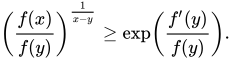
Moreover, f is strictly logarithmically convex if and only if these inequalities are always strict.
If f is twice differentiable, then it is logarithmically convex if and only if, for all x in I,

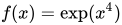
If the inequality is always strict, then f is strictly logarithmically convex. However, the converse is false: It is possible that f is strictly logarithmically convex and that, for some x, we have . For example, if , then f is strictly logarithmically convex, but .


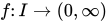
Furthermore, is logarithmically convex if and only if is convex for all .[2][3]


Sufficient conditions
editIf are logarithmically convex, and if are non-negative real numbers, then is logarithmically convex.


If is any family of logarithmically convex functions, then is logarithmically convex.


If is convex and is logarithmically convex and non-decreasing, then is logarithmically convex.



Properties
editA logarithmically convex function f is a convex function since it is the composite of the increasing convex function and the function , which is by definition convex. However, being logarithmically convex is a strictly stronger property than being convex. For example, the squaring function is convex, but its logarithm is not. Therefore the squaring function is not logarithmically convex.



Examples
edit- is logarithmically convex when and strictly logarithmically convex when .
- is strictly logarithmically convex on for all
- Euler's gamma function is strictly logarithmically convex when restricted to the positive real numbers. In fact, by the Bohr–Mollerup theorem, this property can be used to characterize Euler's gamma function among the possible extensions of the factorial function to real arguments.



See also
editNotes
edit- ^ Kingman, J.F.C. 1961. A convexity property of positive matrices. Quart. J. Math. Oxford (2) 12,283-284.
- ^ Montel 1928.
- ^ NiculescuPersson 2006, p. 70.
References
edit- John B. Conway. Functions of One Complex Variable I, second edition. Springer-Verlag, 1995. ISBN 0-387-90328-3.
- "Convexity, logarithmic", Encyclopedia of Mathematics, EMS Press, 2001 [1994]
- Niculescu, Constantin; Persson, Lars-Erik (2006), Convex Functions and their Applications - A Contemporary Approach (1st ed.), Springer, doi:10.1007/0-387-31077-0, ISBN 978-0-387-24300-9, ISSN 1613-5237.
- Montel, Paul (1928), "Sur les fonctions convexes et les fonctions sousharmoniques", Journal de Mathématiques Pures et Appliquées (in French), 7: 29–60.
This article incorporates material from logarithmically convex function on PlanetMath, which is licensed under the Creative Commons Attribution/Share-Alike License.
