Maekawa's algorithm is an algorithm for mutual exclusion on a distributed system. The basis of this algorithm is a quorum-like approach where any one site needs only to seek permissions from a subset of other sites.
Algorithm
editTerminology
edit- A site is any computing device which runs the Maekawa's algorithm
- For any one request of entering the critical section:
- The requesting site is the site which is requesting to enter the critical section.
- The receiving site is every other site which is receiving the request from the requesting site.
- ts refers to the local time stamp of the system according to its logical clock
Algorithm
editRequesting site:
- A requesting site sends a message to all sites in its quorum set .

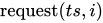

Receiving site:
- Upon reception of a message, the receiving site will:
- If site does not have an outstanding message (that is, a message that has not been released), then site sends a message to site .
- If site has an outstanding message with a process with higher priority than the request, then site sends a message to site and site queues the request from site .
- If site has an outstanding message with a process with lower priority than the request, then site sends an message to the process which has currently been granted access to the critical section by site . (That is, the site with the outstanding message.)
- Upon reception of a message, the site will:
- Send a message to site if and only if site has received a message from some other site or if has sent a yield to some other site but have not received a new .
- Upon reception of a message, site will:
- Send a message to the request on the top of its own request queue. Note that the requests at the top are the highest priority.
- Place into its request queue.
- Upon reception of a message, site will:
- Delete from its request queue.
- Send a message to the request on the top of its request queue.


Critical section:
- Site enters the critical section on receiving a message from all sites in .
- Upon exiting the critical section, sends a message to all sites in .
Quorum set ():
A quorum set must abide by the following properties:

- Site is contained in exactly request sets
![{\displaystyle \forall i\,\forall j\,[R_{i}\bigcap R_{j}\neq \emptyset ]}](https://wikimedia.org/api/rest_v1/media/math/render/svg/f696354afcc2fa3a700b9f331b0f5fe40e55d462)
![{\displaystyle \forall i\,[P_{i}\in R_{i}]}](https://wikimedia.org/api/rest_v1/media/math/render/svg/6321731175473495e8625afeb805349bda62b25c)
![{\displaystyle \forall i\,[|R_{i}|=K]}](https://wikimedia.org/api/rest_v1/media/math/render/svg/994e6e5eb92f9def0d7636260b21184b855abb88)

- Therefore:
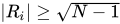
Performance
edit- Number of network messages; to
- Synchronization delay: 2 message propagation delays
- The algorithm can deadlock without protections in place.[1][2]


See also
edit- Lamport's bakery algorithm
- Lamport's Distributed Mutual Exclusion Algorithm
- Ricart–Agrawala algorithm
- Raymond's algorithm
References
edit- M. Maekawa, "A √N algorithm for mutual exclusion in decentralized systems”, ACM
Transactions in Computer Systems, vol. 3., no. 2., pp. 145–159, 1985.
- Mamoru Maekawa, Arthur E. Oldehoeft, Rodney R. Oldehoeft (1987). Operating Systems: Advanced Concept. Benjamin/Cummings Publishing Company, Inc.
- B. Sanders (1987). The Information Structure of Distributed Mutual Exclusion Algorithms. ACM Transactions on Computer Systems, Vol. 3, No. 2, pp. 145–59.
