Molar refractivity,[1][2] , is a measure of the total polarizability of a mole of a substance.

For a perfect dielectric which is made of one type of molecule, the molar refractivity is proportional to the polarizability of a single molecule of the substance. For real materials, intermolecular interactions (the effect of the induced dipole moment of one molecule on the field felt by nearby molecules) give rise to a density dependence.
The molar refractivity is commonly expressed as a sum of components, where the leading order is the value for a perfect dielectric, followed by the density-dependent corrections:

The coefficients are called the refractivity virial coefficients. Some research papers are dedicated to finding the values of the subleading coefficients of different substances. In other contexts, the material can be assumed to be approximately perfect, so that the only coefficient of interest is .


The coefficients depend on the wavelength of the applied field (and on the type and composition of the material), but not on thermodynamic state variables such as temperature or pressure.
The leading order (perfect dielectric) molar refractivity is defined as

where is the Avogadro constant and is the mean polarizability of a molecule.


Substituting the molar refractivity into the Lorentz–Lorenz formula gives, for gasses

where is the refractive index, is the pressure of the gas, is the universal gas constant, and is the (absolute) temperature; the ideal gas law was used here to convert the particle density (appearing in the Lorentz-Lorenz formula) to pressure and temperature.


For a gas, , so the molar refractivity can be approximated by


As mentioned above, despite the relation imposed by the last expression on and , the molar refractivity is a function of the substance itself and not of its conditions, and therefore does not depend on the three state variables appearing in the right hand side of the expression.[a]

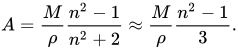
In terms of density ρ and molecular weight M, it can be shown that:
Notes
edit- ^ depends on and , and their variations cancel out in this expression; the advantage in extracting and presenting it as a combination of the other quantities is that it gives an experimental way to measure (one simply needs to measure for a gas with known temperature and pressure).
References
edit- ^ Van Rysselberghe, Pierre (1932). "Remarks concerning the Clausius-Mossotti Law". The Journal of Physical Chemistry. 36 (4). American Chemical Society: 1152–1155. doi:10.1021/j150334a007. ISSN 0092-7325.
- ^ Achtermann, H. J.; Hong, J. G.; Magnus, G.; Aziz, R. A.; Slaman, M. J. (1993). "Experimental determination of the refractivity virial coefficients of atomic gases". The Journal of Chemical Physics. 98 (3): 2308–2318. Bibcode:1993JChPh..98.2308A. doi:10.1063/1.464212. ISSN 0021-9606. Retrieved 2024-11-24.
Bibliography
edit- Born, Max, and Wolf, Emil, Principles of Optics: Electromagnetic Theory of Propagation, Interference and Diffraction of Light (7th ed.), section 2.3.3, Cambridge University Press (1999)ISBN 0-521-64222-1
