1 French Land Register data, which excludes lakes, ponds, glaciers > 1 km2 (0.386 sq mi or 247 acres) and river estuaries.
Saint-Python (French pronunciation:[sɛ̃pitɔ̃]; officially spelt Sainct-Pieton and St-Piton during different periods preceding 1800) is a commune in the Norddepartment in northern France.[3] It was named after Piatus of Tournai. Its inhabitants are called Saint-Piatiens or Piatonnais.
'Python' is a deformation of 'Piatus or Piat'. The church of the commune is also under the name of Saint-Piat also named Piat de Seclin or Piatus of Tournai, thus confirming the origin of the name of the village.[4]
Heraldry
edit
Arms of Saint-Python
The arms of Saint-Python are blazoned : Ermine, 3 lozenges gules.
April 1263: Founding of a chapel belonging to Abbaye Saint-André.[8]
24 February 1416: The Burgundians are housed in Saint-Python.[9]
1437–1440: The écorcheurs (French: [ekɔʁʃœʁ], lit. "flayers") devastated the country including Saint-Python.[10]
1450: The plague struck Saint-Python at least in 1450 and around 1669 (as quoted in Solesmes' Public Registers).
1536: Reconstruction of Saint-Python Church.[citation needed]
1544–1581: The village is periodically abandoned during French occupation of the region, with some inhabitants taking refuge in Cambrai, Valenciennes or Le Quesnoy.[11]
7 July 1637: Landrecies and Le Cateau taken by the French (Turenne). Saint-Python is declared to have been abandoned after taking Landrecies.[citation needed]
On 3 February 1790, voters elected Mr. Duplessy, vicar of St-Python, as public prosecutor, but he refused. On 23 February Etienne Dambrinne was elected prosecutor but already held another office, so the function was given to Mr. Lernou, priest of St-Python. This first municipal act was recorded on a sheet of paper from St-Python's Marlier paper mill, decorated with a drawing of three fleurs-de-lis inside a circle.[14][self-published source]
Georges Flamengt has been mayor of Saint-Python since election in March 2001.
In the 2017 French presidential election, Marine Le Pen came in first place in the 2nd (final) round with 59.41% of the votes in Saint-Python, ahead of Emmanuel Macron (En Marche!) who received 40.59% of the votes. 7.21% of voters returned a blank ballot paper. The participation rate was 77.73% for the 2nd round, a decline in turnout of 1.68 points from the first round of the election.[15]
In 2023, the commune had 978 inhabitants, a decrease of 31% compared to 1968.[16] In January 2019, mayor Georges Flamengt announced two major social projects: a renovation of Haussy Street and the rehabilitation of a former company building into social housing units.[17]
Education
edit
The town has one public primary school: the École maternelle et élémentaire de Saint-Python. It is contractually regulated by the Academy of Lille. Secondary schools include the public Collège Antoine de Saint-Exupéry and the private Catholic Institution Saint-Michel, both located in Solesmes.
Places and monuments
edit
One of the paths of Camino de Santiago the via septentriones templi passes through the village coming from Haussy. It goes through the municipal park, then the church, before leaving by meandering in the streets towards Saint-Vaast-en Cambrésis by hiking trails. Several tags are in fact embedded in the tar, plus two labels on the way.[18]
The smaller Leterme Castle (1908).
Saint-Python has two castles: the Cardon Castle, referred to as "Saint-Python's Castle", and the smaller Leterme Castle. In 1185, Saint-Python's Castle was set on fire by Philip I, Count of Flanders. On 28 September 2007 the castle, which now belongs to the Pavot family, endured another fire devastating the floors and roofs. It was once again restored the following year.
Saint-Python's Church indoors (1905).
Culture
edit
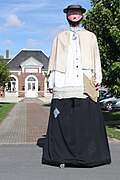
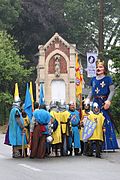
Saint-Python's "Culs de Caudron" celebrations taking place in September and involving the Géants du Nord has been inscribed by UNESCO on the lists of Intangible Cultural Heritage in 2008, originally proclaimed in November 2005 as it is included in the set of folkloric manifestations representing the processional giants and dragons (French: Géants et dragons processionnels) of Belgium and France. Those gigantic figures, incarnating fictitious or real beings, are inherited from medieval rites and are carried or rolled around to dance in the streets during processions or festivals. The "Culs de Caudron" often coincide with a ducasse.[19]
Notable people from the commune
edit
Raymond Poirette (1928–1944): He was born on 16 March 1928 in Solesmes and died on 2 September 1944 in Saint-Python. He was a French Resistant and was arrested and shot dead at close range at 16 years old while he was handing out leaflets near ‘N° 61 of the Rue d'Haussy'. Solesmes' resistance network was headed by Victor Poirette, Raymond's older brother, and Georges Mailloux. Teenagers then served as liaison agents: Raymond Poirette is among them. Their role was to transport documents, weapons, to transmit orders from one point to another. In addition to his role as liaison officer, Raymond participated in some sabotage operations with the aim of hindering the German retreat. As a tribute to the young resistance fighter, several places bear his name, a street in Solesmes and a school restaurant in Saint-Python.[20]
Bibliography
edit
Louis Boniface, Etude sur la signification des noms topographiques de l'arrondissement de Cambrai, Valenciennes, Impr. Louis Henry, 1866.
^Mannier, Eugène (1861). Eugène Mannier, Études étymologiques, historiques et comparatives sur les noms des villes, bourgs et villages du département du Nord. Paris: Auguste Aubry, Libraire-Éditeur.
^Turquin, Pierre (1955). "The Battle of the Sabis (La Bataille de la Selle – du Sabis)". Les Études Classiques. 23/2: 111–157.
^Duvivier, C. (1865). Recherches Sur Le Hainaut Ancien (Pagus Hainoensis) Du Viie Au Xiie Siecles. Paris: HACHETTE LIVRE. ISBN9782012621978. {{cite book}}: ISBN / Date incompatibility (help)
^Hossart, Philippe (1792). Histoire Ecclésiastique Et Profane Du Hainaut. bibliothèque de l'État de Bavière: Lelong.
^Meresse, Abbe (2004). History of Cateau-Cambresis. Lorisse. ISBN9782877607728.
^Deloffre, Guy (1985). Guerres et brigandages au XVe siècle en Hainaut, Pays d'Avesnes, Thiérache et Ardennes. Paris: Mémoire de la Société archéologique et historique d'Avesnes.
^Contamine, Philippe (2004). Guerre, État et société à la fin du Moyen Âge. Études sur les armées des rois de France (1337–1494). Paris: Éditions de l'École des Hautes Études en Sciences Sociales (EHESS). pp. 450, 334.
^de Combles, Waroquier (1785). État de la France, ou les vrais marquis, comtes, vicomtes et barons. National Library of the Netherlands: Clousier.
^Peter; Poulet, chanoine J. (1930). Religious History of the Department of the North during the Revolution (1789–1802) [Histoire religieuse du département du Nord pendant la Révolution (1789–1802)]. Lille: Publivations des Facultés Catholiques (Volume I. From the end of the Ancien Régime to 9 Thermidor year II – 28 July 1794).{{cite book}}: CS1 maint: multiple names: authors list (link)
The ball python (Python regius), also called the royal python, is a python species native to West and Central Africa, where it lives in grasslands, shrublands
The Burmese python (Python bivittatus) is one of the largest species of snakes. It is native to a large area of Southeast Asia and is listed as Vulnerable
Monty Python, also known as the Pythons, were a British comedy troupe formed in 1969 consisting of Graham Chapman, John Cleese, Terry Gilliam, Eric Idle
In Greek mythology, Python (Ancient Greek: Πύθων; gen. Πύθωνος) was the serpent, sometimes represented as a medieval-style dragon, living at the center
Mons-en-Pévèle and the Carrefour de l'Arbre. Three sections (Quiévy, Saint-Python and Verchain-Maugré) were included in stage 4 of the 2015 Tour de France
Monty Python's Flying Circus is a British surreal sketch comedy series created by and starring Graham Chapman, John Cleese, Eric Idle, Terry Jones, Michael