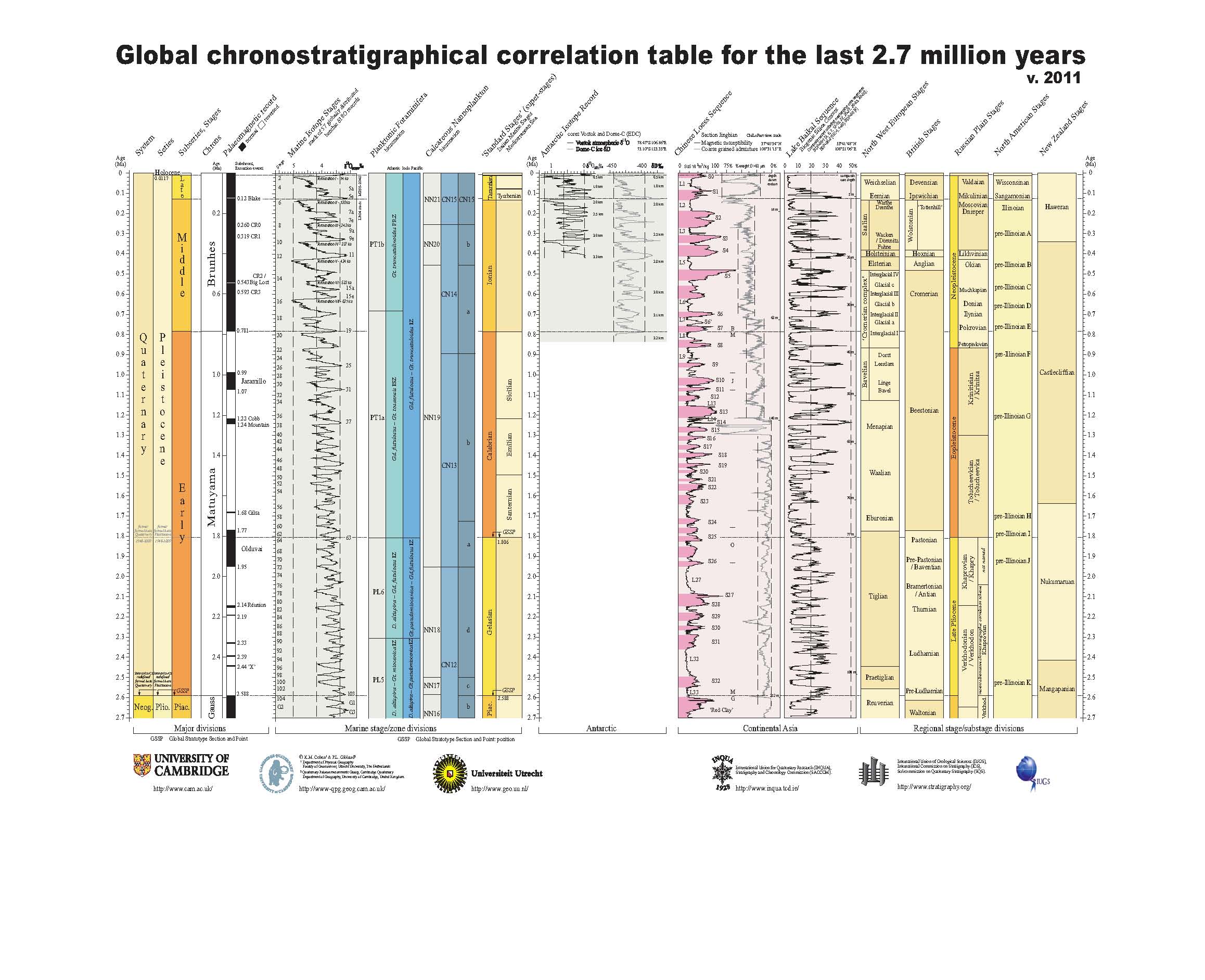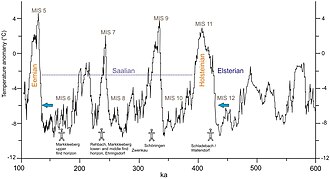
The Holstein or Holsteinian interglacial (German: Holstein-Warmzeit or Holstein-Interglazial), also called the Mindel-Riss interglacial (Mindel-Riß-Interglazial) in the Alpine region, is the third to last major interglacial in Europe before the Holocene, the present warm period. It followed directly after the Elster glaciation and came before the Saale glaciation, during the Middle Pleistocene. The more precise timing was historically controversial since Holstein was commonly correlated to two different marine isotope stages, MIS 11[1] (424–374 thousand years ago[2]) and MIS 9[3] (337–300 thousand years ago[2]). Recent scholarship has supported a MIS 11 date, spanning approximately 421-395,000 years ago.[4]
Definition
editThe Holstein interglacial is defined by marine sedimentation. On the stratigraphic record at the natural monument of de:Sievertsche Tongrube in Hamburg-Hummelsbüttel, its development is traced from the Elster ice age (Lauenburg clay) through the start of the warm period (freshwater depositions) to its flooding by the Holstein Sea (Cardien Sands).[5][6][7][8][9]
See also
editReferences
edit- ^ Subcommission on Quaternary Stratigraphy, Global chronostratigraphical correlation table for the last 2.7 million years, v. 2011
- ^ a b Lisiecki, Lorraine E.; Raymo, Maureen E. (2005). "A Pliocene-Pleistocene stack of 57 globally distributed benthic δ18O records". Paleoceanography. 20 (1): n/a. Bibcode:2005PalOc..20.1003L. doi:10.1029/2004PA001071. hdl:2027.42/149224. S2CID 12788441.
- ^ German Stratigraphic Commission: Stratigraphische Tabelle von Deutschland 2016
- ^ Fernández Arias, Sophie; Förster, Michael W.; Sirocko, Frank (August 2023). "Rieden tephra layers in the Dottinger Maar lake sediments: Implications for the dating of the Holsteinian interglacial and Elsterian glacial". Global and Planetary Change. 227 104143. doi:10.1016/j.gloplacha.2023.104143.
- ^ Grube, E.-F. (1959): Die Bedeutung des Holstein-Interglazial-Aufschlusses von Hamburg-Hummelsbüttel für die Geologie Norddeutschlands. – Jahrbuch des Alstervereins: 5–9.
- ^ Grube, E.-F. (1963): Geologie der Ziegelei-Tongruben von Hamburg-Hummelsbüttel. – Jahrbuch des Alstervereins 42: 25–30.
- ^ Averdieck, F.-R. (1992): Das Holstein-Interglazial von Hamburg-Hummelsbüttel. – Meyniana 44: 1–13.
- ^ Dallek, M. (1963): Holstein-Interglazialvorkommen von Hamburg-Hummelsbüttel. – Jahrbuch des Deutschen Jugendbundes für Naturbeobachtung 2: 136–147.
- ^ Knudsen, K.L. (1979): Foraminiferal Faunas in Marine Holsteinian Interglacial Deposits of Hamburg-Hummelsbüttel. – Mitteilungen aus dem Geologisch-Paläontologischen Institut der Universität Hamburg 49: 193–214.
Literature
edit- Hallik, R. (1960): Die Vegetationsentwicklung der Holstein-Warmzeit in Nordwestdeutschland und die Altersstellung der Kieselgurlager der südlichen Lüneburger Heide. – Zeitschrift der Deutschen Geologischen Gesellschaft 112: 326–333.