In mathematics, the Fox–Wright function (also known as Fox–Wright Psi function, not to be confused with Wright Omega function) is a generalisation of the generalised hypergeometric function pFq(z) based on ideas of Charles Fox (1928) and E. Maitland Wright (1935):
![{\displaystyle {}_{p}\Psi _{q}\left[{\begin{matrix}(a_{1},A_{1})&(a_{2},A_{2})&\ldots &(a_{p},A_{p})\\(b_{1},B_{1})&(b_{2},B_{2})&\ldots &(b_{q},B_{q})\end{matrix}};z\right]=\sum _{n=0}^{\infty }{\frac {\Gamma (a_{1}+A_{1}n)\cdots \Gamma (a_{p}+A_{p}n)}{\Gamma (b_{1}+B_{1}n)\cdots \Gamma (b_{q}+B_{q}n)}}\,{\frac {z^{n}}{n!}}.}](https://wikimedia.org/api/rest_v1/media/math/render/svg/9ab45ae4b1283978ae4ccb07a7a46a36957d9fb4)
Upon changing the normalisation
![{\displaystyle {}_{p}\Psi _{q}^{*}\left[{\begin{matrix}(a_{1},A_{1})&(a_{2},A_{2})&\ldots &(a_{p},A_{p})\\(b_{1},B_{1})&(b_{2},B_{2})&\ldots &(b_{q},B_{q})\end{matrix}};z\right]={\frac {\Gamma (b_{1})\cdots \Gamma (b_{q})}{\Gamma (a_{1})\cdots \Gamma (a_{p})}}\sum _{n=0}^{\infty }{\frac {\Gamma (a_{1}+A_{1}n)\cdots \Gamma (a_{p}+A_{p}n)}{\Gamma (b_{1}+B_{1}n)\cdots \Gamma (b_{q}+B_{q}n)}}\,{\frac {z^{n}}{n!}}}](https://wikimedia.org/api/rest_v1/media/math/render/svg/b2c530d8bd1ce434141c9d2b83eb3c98d9b22fa0)
it becomes pFq(z) for A1...p = B1...q = 1.
The Fox–Wright function is a special case of the Fox H-function (Srivastava & Manocha 1984, p. 50):
![{\displaystyle {}_{p}\Psi _{q}\left[{\begin{matrix}(a_{1},A_{1})&(a_{2},A_{2})&\ldots &(a_{p},A_{p})\\(b_{1},B_{1})&(b_{2},B_{2})&\ldots &(b_{q},B_{q})\end{matrix}};z\right]=H_{p,q+1}^{1,p}\left[-z\left|{\begin{matrix}(1-a_{1},A_{1})&(1-a_{2},A_{2})&\ldots &(1-a_{p},A_{p})\\(0,1)&(1-b_{1},B_{1})&(1-b_{2},B_{2})&\ldots &(1-b_{q},B_{q})\end{matrix}}\right.\right].}](https://wikimedia.org/api/rest_v1/media/math/render/svg/ffe83e472f89f4a998dc750566a980c28def03b3)
Wright function
editThe entire function is often called the Wright function.[1] It is the special case of of the Fox–Wright function. Its series representation is

![{\displaystyle {}_{0}\Psi _{1}\left[\ldots \right]}](https://wikimedia.org/api/rest_v1/media/math/render/svg/3d4d213f41c4cbec3b33408d2c2e338039817259)

This function is used extensively in fractional calculus. Recall that . Hence, a non-zero with zero is the simplest nontrivial extension of the exponential function in such context.



Three properties were stated in Theorem 1 of Wright (1933)[2] and 18.1(30–32) of Erdelyi, Bateman Project, Vol 3 (1955)[3] (p. 212)
![{\displaystyle {\begin{aligned}\lambda zW_{\lambda ,\mu +\lambda }(z)&=W_{\lambda ,\mu -1}(z)+(1-\mu )W_{\lambda ,\mu }(z)&(a)\\[6pt]{d \over dz}W_{\lambda ,\mu }(z)&=W_{\lambda ,\mu +\lambda }(z)&(b)\\[6pt]\lambda z{d \over dz}W_{\lambda ,\mu }(z)&=W_{\lambda ,\mu -1}(z)+(1-\mu )W_{\lambda ,\mu }(z)&(c)\end{aligned}}}](https://wikimedia.org/api/rest_v1/media/math/render/svg/a07b7f942cb218ae53fc4b1889e67096fc264977)
Equation (a) is a recurrence formula. (b) and (c) provide two paths to reduce a derivative. And (c) can be derived from (a) and (b).
A special case of (c) is . Replacing with , we have



![{\displaystyle {\begin{array}{lcl}x{d \over dx}W_{-c\alpha ,0}(-x^{\alpha })&=&-{\frac {1}{c}}\left[W_{-c\alpha ,-1}(-x^{\alpha })+W_{-c\alpha ,0}(-x^{\alpha })\right]\end{array}}}](https://wikimedia.org/api/rest_v1/media/math/render/svg/bfe07892a2fb601ec2f29988305f4a2beda9a29a)
A special case of (a) is . Replacing with , we have



Two notations, and , were used extensively in the literatures:


![{\displaystyle {\begin{aligned}M_{\alpha }(z)&=W_{-\alpha ,1-\alpha }(-z),\\[1ex]\implies F_{\alpha }(z)&=W_{-\alpha ,0}(-z)=\alpha zM_{\alpha }(z).\end{aligned}}}](https://wikimedia.org/api/rest_v1/media/math/render/svg/97ecbfca463abbfd3d327dfa481c9acc621f7f7d)
M-Wright function
editis known as the M-Wright function, entering as a probability density in a relevant class of self-similar stochastic processes, generally referred to as time-fractional diffusion processes.
Its properties were surveyed in Mainardi et al (2010).[4]
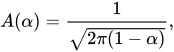
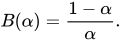
Its asymptotic expansion of for is where


See also
edit
- Prabhakar function
- Hypergeometric function
- Generalized hypergeometric function
- Modified half-normal distribution
References
edit- ^ Weisstein, Eric W. "Wright Function". From MathWorld--A Wolfram Web Resource. Retrieved 2022-12-03.
- ^ Wright, E. (1933). "On the Coefficients of Power Series Having Exponential Singularities". Journal of the London Mathematical Society. Second Series: 71–79. doi:10.1112/JLMS/S1-8.1.71. S2CID 122652898.
- ^ Erdelyi, A (1955). The Bateman Project, Volume 3. California Institute of Technology.
- ^ Mainardi, Francesco; Mura, Antonio; Pagnini, Gianni (2010-02-11). "The M-Wright Function in Time-Fractional Diffusion Processes: A Tutorial Survey". International Journal of Differential Equations. 2010 (1) 104505. doi:10.1155/2010/104505.
- Fox, C. (1928). "The asymptotic expansion of integral functions defined by generalized hypergeometric series". Proc. London Math. Soc. 27 (1): 389–400. doi:10.1112/plms/s2-27.1.389.
- Wright, E. M. (1935). "The asymptotic expansion of the generalized hypergeometric function". J. London Math. Soc. 10 (4): 286–293. doi:10.1112/jlms/s1-10.40.286.
- Wright, E. M. (1940). "The asymptotic expansion of the generalized hypergeometric function". Proc. London Math. Soc. 46 (2): 389–408. doi:10.1112/plms/s2-46.1.389.
- Wright, E. M. (1952). "Erratum to "The asymptotic expansion of the generalized hypergeometric function"". J. London Math. Soc. 27: 254. doi:10.1112/plms/s2-54.3.254-s.
- Srivastava, H.M.; Manocha, H.L. (1984). A treatise on generating functions. E. Horwood. ISBN 0-470-20010-3.
- Miller, A. R.; Moskowitz, I.S. (1995). "Reduction of a Class of Fox–Wright Psi Functions for Certain Rational Parameters". Computers Math. Applic. 30 (11): 73–82. doi:10.1016/0898-1221(95)00165-u.
- Sun, Jingchao; Kong, Maiying; Pal, Subhadip (22 June 2021). "The Modified-Half-Normal distribution: Properties and an efficient sampling scheme". Communications in Statistics – Theory and Methods. 52 (5): 1591–1613. doi:10.1080/03610926.2021.1934700. ISSN 0361-0926. S2CID 237919587.
