In mathematics, Helly's selection theorem (also called the Helly selection principle) states that a uniformly bounded sequence of monotone real functions admits a convergent subsequence. In other words, it is a sequential compactness theorem for the space of uniformly bounded monotone functions. It is named for the Austrian mathematician Eduard Helly. A more general version of the theorem asserts compactness of the space BVloc of functions locally of bounded total variation that are uniformly bounded at a point.
The theorem has applications throughout mathematical analysis. In probability theory, the result implies compactness of a tight family of measures.
Statement of the theorem
editLet (fn)n ∈ N be a sequence of increasing functions mapping a real interval I into the real line R, and suppose that it is uniformly bounded: there are a,b ∈ R such that a ≤ fn ≤ b for every n ∈ N. Then the sequence (fn)n ∈ N admits a pointwise convergent subsequence.
Proof
editThe proof requires the basic facts about monotonic functions: An increasing function f on an interval I has at most countably many points of discontinuity.
Step 1. Inductive Construction of a subsequence converging at discontinuities and rationals (diagonal process).
editLet be the set of discontinuities of ; each of these sets are countable by the above basic fact. The set is countable, and it can be denoted as .


By the uniform boundedness of and the Bolzano–Weierstrass theorem, there is a subsequence such that converges. Suppose has been chosen such that converges for , then by uniform boundedness and Bolzano–Weierstrass, there is a subsequence of such that converges, thus converges for .



Let , then is a subsequence of that converges pointwise everywhere in .


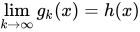
Step 2. gk converges in I except possibly in an at most countable set.
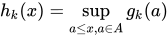
editLet , then, hk(a)=gk(a) for a∈A, hk is increasing, let , then h is increasing, since supremes and limits of increasing functions are increasing, and for a∈ A by Step 1. Moreover, h has at most countably many discontinuities.


We will show that gk converges at all continuities of h. Let x be a continuity of h, q,r∈ A, q<x<r, then ,hence


Thus,

Since h is continuous at x, by taking the limits , we have , thus


Step 3. Choosing a subsequence of gk that converges pointwise in I
editThis can be done with a diagonal process similar to Step 1.
With the above steps we have constructed a subsequence of (fn)n ∈ N that converges pointwise in I.
Generalisation to BVloc
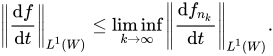
editLet U be an open subset of the real line and let fn : U → R, n ∈ N, be a sequence of functions. Suppose that (fn) has uniformly bounded total variation on any W that is compactly embedded in U. That is, for all sets W ⊆ U with compact closure W̄ ⊆ U,
- where the derivative is taken in the sense of tempered distributions.

Then, there exists a subsequence fnk, k ∈ N, of fn and a function f : U → R, locally of bounded variation, such that
- fnk converges to f pointwise almost everywhere;
- and fnk converges to f locally in L1 (see locally integrable function), i.e., for all W compactly embedded in U,
- [1]: 132

- and, for W compactly embedded in U,
- [1]: 122
Further generalizations
editThere are many generalizations and refinements of Helly's theorem. The following theorem, for BV functions taking values in Banach spaces, is due to Barbu and Precupanu:
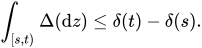
Let X be a reflexive, separable Hilbert space and let E be a closed, convex subset of X. Let Δ : X → [0, +∞) be positive-definite and homogeneous of degree one. Suppose that zn is a uniformly bounded sequence in BV([0, T]; X) with zn(t) ∈ E for all n ∈ N and t ∈ [0, T]. Then there exists a subsequence znk and functions δ, z ∈ BV([0, T]; X) such that
- for all t ∈ [0, T],
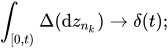
- and, for all t ∈ [0, T],

- and, for all 0 ≤ s < t ≤ T,
See also
editReferences
edit- ^ a b Ambrosio, Luigi; Fusco, Nicola; Pallara, Diego (2000). Functions of Bounded Variation and Free Discontinuity Problems. Oxford University Press. doi:10.1093/oso/9780198502456.001.0001. ISBN 9780198502456.
- Rudin, W. (1976). Principles of Mathematical Analysis. International Series in Pure and Applied Mathematics (Third ed.). New York: McGraw-Hill. 167. ISBN 978-0070542358.
- Barbu, V.; Precupanu, Th. (1986). Convexity and optimization in Banach spaces. Mathematics and its Applications (East European Series). Vol. 10 (Second Romanian ed.). Dordrecht: D. Reidel Publishing Co. xviii+397. ISBN 90-277-1761-3. MR 0860772
