| Parthenocissus inserta | |
|---|---|

| |
Scientific classification 
| |
| Kingdom: | Plantae |
| Clade: | Tracheophytes |
| Clade: | Angiosperms |
| Clade: | Eudicots |
| Clade: | Rosids |
| Order: | Vitales |
| Family: | Vitaceae |
| Genus: | Parthenocissus |
| Species: | P. inserta
|
| Binomial name | |
| Parthenocissus inserta (A.Kern.) Fritsch
| |
| Synonyms[1] | |
| |
Parthenocissus inserta (syn. Parthenocissus vitacea), also known as thicket creeper, false Virginia creeper, woodbine, or grape woodbine, is a woody vine native to North America. Contact with it may cause dermatitis.
Description
editParthenocissus inserta is a climbing and sprawling woody vine (liana), reaching lengths of 20 metres (66 ft), using small branched tendrils with twining tips.[2] The leaves are palmately compound, composed of five leaflets, each leaflet reaching 13 centimetres (5 in) in length and 7 cm broad. The leaflets have a coarsely toothed margin.[2]
The flowers are small and greenish, produced in clusters in late spring, and mature in late summer or early fall into small blue-black berries.[2] The berries are up to 1.5 cm (1⁄2 in) wide and palatable.[3] They contain oxalates.[4]
Similar species
editParthenocissus inserta is closely related to and commonly confused with Parthenocissus quinquefolia (Virginia creeper).[5] They differ in their means of climbing, with the tendrils twining around plant stems in P. inserta lacking the round, adhesive discs found on the tendril tips of P. quinquefolia, though the ends may be club-shaped when inserted into a crevice.[6] One consequence of this is that (unlike P. quinquefolia) it cannot climb smooth walls, only through shrubs and trees. In addition, the leaflets of P. inserta are shiny when young and only slightly pale below, while those of P. quinquefolia are dull above and pale green, whitened, or glaucous below.[6] P. inserta flowerhead branching is dichotomous or trichotomous, with branches of equal thickness, while P. quinquefolia branches unequally, with a definite central axis.[6] The berries of P. inserta are larger, 8–12 millimetres (3⁄8–1⁄2 in) in diameter, versus 5–8 mm broad in P. quinquefolia.[7] The petiolules of mature P. inserta leaflets are typically 5–30 mm (1⁄4–1+1⁄8 in) long, versus sessile or up to 10 mm in P. quinquefolia.[8]
Taxonomy
editParthenocissus inserta was first described in 1887 by Anton Kerner, as Vitis inserta. It was transferred to Parthenocissus by Karl Fritsch in 1922.[9] Separately, in 1893, Ellsworth Brownell Knerr described it as the variety vitacea of Ampelopsis quinquefolia (a synonym of Parthenocissus quinquefolia). Albert Spear Hitchcock raised the variety to the full species Parthenocissus vitacea in 1894.[10] Kerner's epithet inserta has priority over Knerr's vitacea, so the correct name is Parthenocissus inserta.
Distribution and habitat
editIt can be found in southeastern Canada (west to southern Manitoba) and a large area of the United States, from Maine west to Montana and south to New Jersey and Missouri in the east, and Texas to Arizona in the west. It is becoming invasive in northeast Louisiana. It is present in California, but it may be an introduced species that far west.[11] It is introduced in Europe.
Ecology
editThe flowers of thicket creeper are frequently visited by Mordella marginata, a tumbling flower beetle.[12] Several bee species have been observed collecting pollen from the flowers, including the sweat bees Augochlora pura, Lasioglossum subviridatum, and Lasioglossum zephyrus.[12] The fruits are eaten by birds.[13]
-
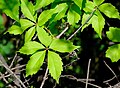 Leaves and tendrils
 -
 Flowers
 -
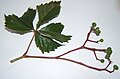 Detail of berries
Health concerns
editThe plant may cause dermatitis.[4]
References
edit- ^ "Parthenocissus inserta (A.Kern.) Fritsch", Plants of the World Online, Royal Botanic Gardens, Kew, retrieved 2018-10-18
- ^ a b c Chayka, Katy; Dziuk, Peter. "Parthenocissus inserta (Woodbine)". minnesotawildflowers.info. MinnesotaWildflowers. Retrieved 2018-10-18.
- ^ Turner, Mark; Kuhlmann, Ellen (2014). Trees & Shrubs of the Pacific Northwest (1st ed.). Portland, OR: Timber Press. p. 409. ISBN 978-1-60469-263-1.
- ^ a b Calflora
- ^ "Parthenocissus inserta: Similar Species". iNaturalist.org. iNaturalist. Retrieved 2018-10-18.
- ^ a b c Reznicek, A. A.; Voss, E. G.; Walters, B. S., eds. (February 2011). "Parthenocissus". Michigan Flora Online. University of Michigan Herbarium. Retrieved 2018-10-18.
- ^ Moore, Michael O.; Wen, Jun (2016). "Parthenocissus". In Flora of North America Editorial Committee (ed.). Flora of North America North of Mexico (FNA). Vol. 12. New York and Oxford: Oxford University Press. Retrieved 2018-10-18 – via eFloras.org, Missouri Botanical Garden, St. Louis, MO & Harvard University Herbaria, Cambridge, MA.
- ^ "Dichotomous Key: Parthenocissus". gobotany.nativeplanttrust.org. New England Wild Flower Society. Retrieved 2018-10-18.
- ^ "Plant Name Details for Parthenocissus inserta (A.Kern.) Fritsch", The International Plant Names Index, retrieved 2018-10-18
- ^ "Plant Name Details for Parthenocissus vitacea (Knerr) Hitchc.", The International Plant Names Index, retrieved 2018-10-18
- ^ Jepson Manual Treatment
- ^ a b Wilhelm, Gerould; Rericha, Laura (2017). Flora of the Chicago Region: A Floristic and Ecological Synthesis. Indiana Academy of Sciences.
- ^ Carpenter, Anita (October 2001). "The vine that twines". Wisconsin Natural Resources Magazine. Wisconsin Department of Natural Resources. Archived from the original on 2010-08-22. Retrieved 2018-10-19.
