| Indo-Iran
Arya | |||||||||
|---|---|---|---|---|---|---|---|---|---|
| Wilayah | Asia Selatan, Tengah, dan Barat | ||||||||
Penutur | |||||||||
| |||||||||
| Kode bahasa | |||||||||
| ISO 639-3 | – | ||||||||
| ISO 639-5 | iir | ||||||||
LINGUIST List  | indi | ||||||||
| Glottolog | indo1320[1] | ||||||||
| IETF | iir | ||||||||
| Lokasi penuturan | |||||||||
 Penyebaran bahasa-bahasa Indo-Iran di kawasan Eurasia
Indo-Iran | |||||||||
 Portal Bahasa Portal Bahasa | |||||||||


| Artikel ini adalah bagian dari seri: |
| Topik Indo-Eropa |
|---|
 |
Rumpun bahasa Indo-Iran, juga disebut rumpun bahasa Arya,[2][3] merupakan salah satu subrumpun bahasa dari rumpun bahasa Indo-Eropa.[4] Rumpun bahasa ini dituturkan di wilayah timur dan memiliki jumlah penutur lebih dari 1 miliar jiwa yang tersebar dari Kaukasus (Osetia) dan Semenanjung Balkan (Romani) di barat sampai Xinjiang (Sarikoli) dan Assam (Assam), hingga Maladewa (Divehi) di selatan.
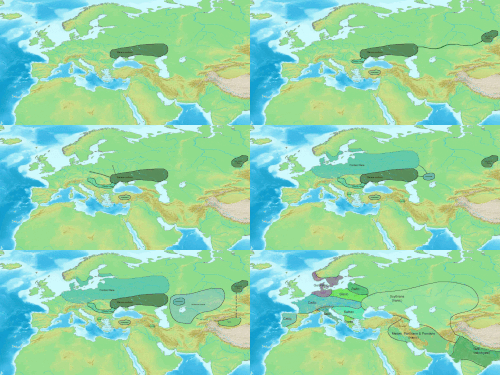
Leluhur dari semua bahasa di keluarga ini disebut sebagai Proto-Indo-Iran, juga dikenal sebagai bangsa Arya, yang dituturkan di sekitar akhir milenium ke-3 SM di stepa Eurasia di Asia Tengah. Tiga cabang bahasa Indo-Iran modern adalah Indo-Arya, Iran, dan Nuristani.[5]
Bahasa
suntingRumpun bahasa Indo-Iran terdiri dari tiga sub-rumpun:
- Indo-Arya/Indik, sebagian besar dituturkan di Subbenua India
- Iran-Arya/Iranik, sebagian besar dituturkan di Dataran Tinggi Iran dan Asia Tengah
- Nuristan: dituturkan di perbatasan Afganistan dan Pakistan
Rumpun bahasa Indo-Iran dituturkan oleh lebih dari 1,5 miliar jiwa. Bahasa dengan penutur terbanyak adalah bagian dari cabang Indo-Arya: Hindi-Urdu (~590 juta karena sensus India sering kali mencakup Bhojpuri (40 juta), Awadhi (40 juta), Maithili (35 juta), Marwari (30 juta), Rajasthani (20 juta), Chhattisgarhi (18 juta), dan Kumaoni (2.1 juta) sebagai dialek-dialeknya), Bengali (205 juta),[6] Punjabi (100 juta), Marathi (90 juta), Gujarati (50 juta), Oriya (35 juta), Sindhi (25 juta), Assam (24 juta), Sinhala (19 juta), Nepal (17 juta), dan Bishnupriya (12 juta).[7] Di antara cabang Iran, bahasa utamanya adalah Persia (110 juta), Pashtun (40 juta), Kurdi (35 juta),[8] dan Baluchi (8 juta).
Referensi
suntingCatatan kaki
sunting- ^ Hammarström, Harald; Forkel, Robert; Haspelmath, Martin, ed. (2023). "Indo-Iran". Glottolog 4.8. Jena, Jerman: Max Planck Institute for the Science of Human History. ; ;
- ^ Annarita Puglielli; Mara Frascarelli (2011). Linguistic Analysis: From Data to Theory. Walter de Gruyter. ISBN 978-3-11-022250-0.
- ^ Jadranka Gvozdanović (1999). Numeral Types and Changes Worldwide. Walter de Gruyter. hlm. 221. ISBN 978-3-11-016113-7.: "The usage of 'Aryan languages' is not to be equated with Indo-Aryan languages, rather Indo-Iranic languages of which Indo-Aryan is a subgrouping."
- ^ Nasution, Sahkholid (2017). Kholison, Moh. (ed.). Pengantar Linguistik Bahasa Arab (PDF). Sidoarjo: CV. Lisan Arabi. hlm. 61. ISBN 978-602-70113-8-0. Pemeliharaan CS1: Status URL (link)
- ^ Bashir, Elena (2007). Jain, Danesh; Cardona, George (ed.). The Indo-Aryan languages. hlm. 905. ISBN 978-0415772945.
'Dardic' is a geographic cover term for those Northwest Indo-Aryan languages which [..] developed new characteristics different from the IA languages of the Indo-Gangetic plain. Although the Dardic and Nuristani (previously 'Kafiri') languages were formerly grouped together, Morgenstierne (1965) has established that the Dardic languages are Indo-Aryan, and that the Nuristani languages constitute a separate subgroup of Indo-Iranian.
- ^ Thompson, Irene. "Bengali". AboutWorldLanguages. Diakses tanggal 29 March 2013.
- ^ "Census of India: Family-wise grouping of the 122 Scheduled and Non-Scheduled Languages -2001". www.censusindia.gov.in.
- ^ CIA- The World Factbook: 14.7 million in Turkey (18%)[1][Verifikasi gagal], 4.9–6.5 million in Iraq (15-20%)[2][Verifikasi gagal], 8 million in Iran (10%)"Archived copy". Diakses tanggal 31 Maret 2011.[Verifikasi gagal] (all for 2014), plus several million in Syria, neighboring countries, and the diaspora
Daftar pustaka
sunting- Chakrabarti, Byomkes (1994). A comparative study of Santali and Bengali. Calcutta: K.P. Bagchi & Co. ISBN 81-7074-128-9
- Nicholas Sims-Williams, ed. (2002). Indo-Iranian Languages and Peoples. Oxford University Press.
- "Contact and change in the diversification of the Indo-Iranic languages" (PDF). Dr. Russell Gray.
- Pinault, Georges-Jean. "Contacts religieux et culturels des Indo-Iraniens avec la civilisation de l'Oxus". In: Comptes rendus des séances de l'Académie des Inscriptions et Belles-Lettres, 149e année, N. 1, 2005. pp. 213–257. DOI:https://doi.org/10.3406/crai.2005.22848 ; www.persee.fr/doc/crai_0065-0536_2005_num_149_1_22848
- Pinault, Georges-Jean. "La langue des Scythes et le nom des Arimaspes". In: Comptes rendus des séances de l'Académie des Inscriptions et Belles-Lettres, 152e année, N. 1, 2008. pp. 105–138. DOI:https://doi.org/10.3406/crai.2008.92104 ; www.persee.fr/doc/crai_0065-0536_2008_num_152_1_92104
- Baly, Joseph. Eur-Aryan roots: With their English derivatives and the corresponding words in the cognate languages compared and systematically arranged. Vol. 1. K. Paul, Trench, Trubner & Company, Limited, 1897.
Pranala luar
sunting

